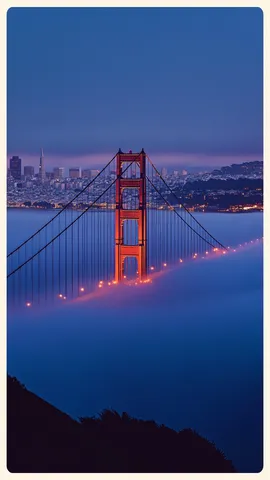
There is a moment on the approach to San Francisco that no other airport in the world can replicate. The aircraft descends over the bay. Below you, the water catches the late afternoon light and throws it back in pieces. The bridges appear: one red, one silver. The city rises from the peninsula like something that should not be there, too vertical for the land, too beautiful for a Tuesday. You are still twenty minutes from the gate and you are already somewhere.
San Francisco International sits on the edge of the bay with its runways reaching over the water. It is not the most efficient airport in America. It is not the largest. What it is, on the right afternoon, with the fog holding back and the light coming across the hills from the west, is the most beautiful approach to any city on Earth. The dream does not start when you get to the city. It starts when you see it from the air.
The airport itself has decided to match that promise. SFO is the only airport in the world with an accredited museum. Two percent of every construction dollar spent here, by law since 1977, goes to public art: over thirty commissioned works in the new terminal alone, plus fourteen gallery spaces running rotating exhibitions across the full complex. The city that invented the counterculture, the gay rights movement, the personal computer, and sourdough bread has built an airport that takes culture as seriously as it takes gate capacity.
If you are passing through, slow down. The city outside is extraordinary. So is the terminal you are standing in.
Every world-changing idea.
Starts with landing in SFO.
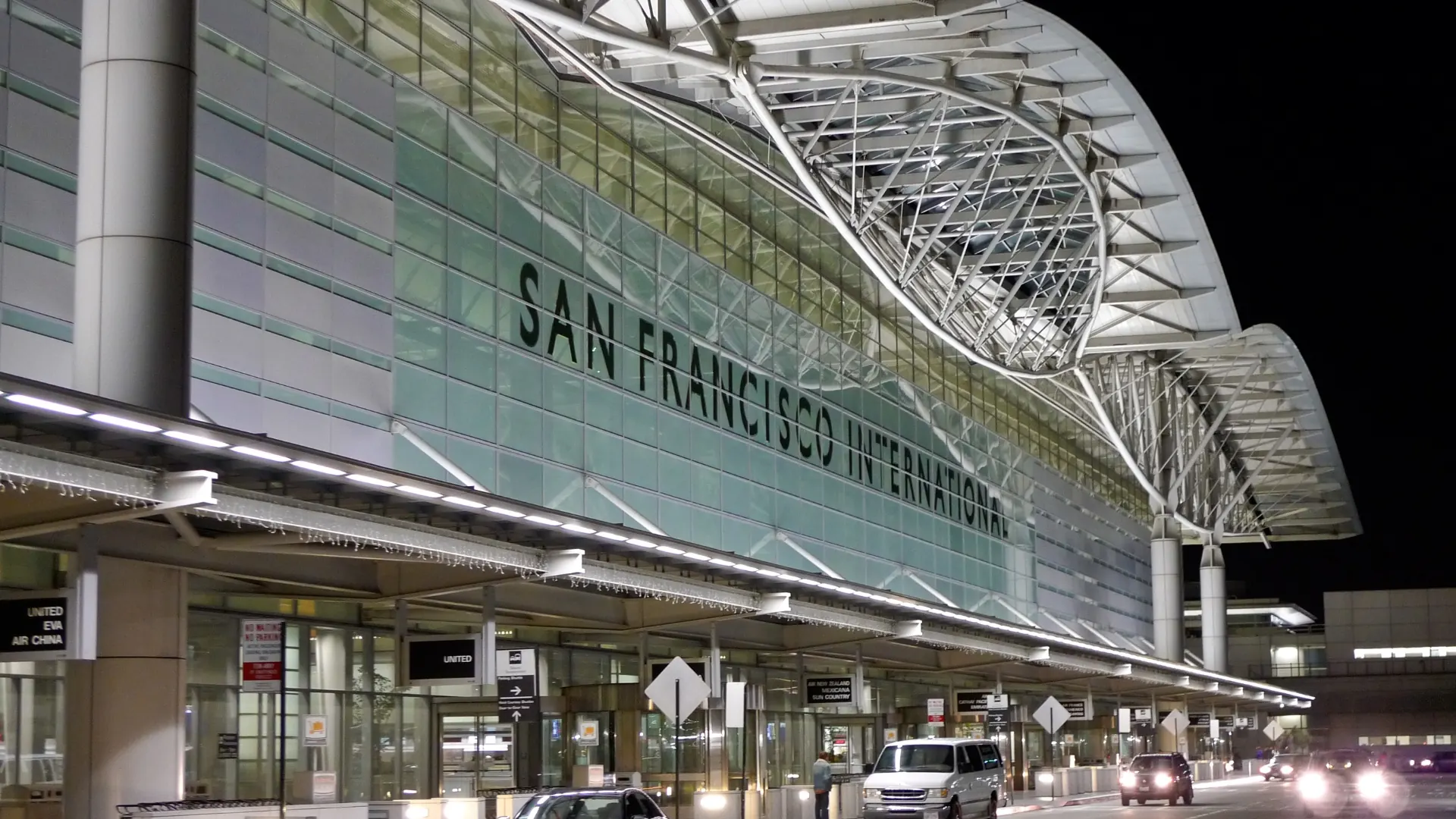
SFO's signature is a terminal that carries a city's values above the departure gates.
The two-point-five-billion-dollar terminal completed its final phase in June 2024 and was named the world's most beautiful airport by the Prix Versailles in December 2025, judged at UNESCO headquarters in Paris. It is the first terminal in the world named after an LGBTQ civil rights leader. His name is above the departure gates. His portrait is in the hall. A permanent photographic exhibition on the departures level traces his life from Long Island to Castro Street to City Hall. This is not airport branding. This is a city deciding that its airport should carry its values out into the world with every departing flight.

The art inside Terminal 1 is not decoration. The 2%-for-Art ordinance has funded over thirty commissioned works in this building alone: mosaics, sculptures, ceiling installations, and a green map of the Bay Area that inverts the usual logic of cartography by showing only parks and open water, no roads, no cities. The SFO Museum operates twenty-five gallery sites throughout the terminals. Founded in 1980, it is the only accredited museum inside any airport on Earth. Exhibitions rotate across art, history, photography, science, and culture. Some are pre-security and open to anyone who walks through the door. The Aviation Museum and Library in the International Terminal holds over a hundred and sixty thousand objects on the history of commercial flight. It is open daily and costs nothing.
Green Apple Books has an airside outpost in Terminal 1, stocked by one of San Francisco's most beloved independent bookshops. Ritual Coffee is next to it. These are not franchise concessions dropped into a terminal. They are the actual places that San Franciscans use, relocated inside the departure lounge because the airport decided that leaving the city should feel like it.
Through the new connector walkway that links all terminals post-security, the whole airport becomes navigable. The fog rolls in off the bay and presses against the windows. The light inside holds steady. This is a good place to spend a few hours.


The secret to eating well at SFO is to eat California. Not the version you find at airports that have decided to feel Californian. The actual thing: local producers, seasonal ingredients, food that knows where it came from.
Napa Farms Market in Terminal 2 is the most consistently right answer in the building. An artisan grab-and-go that stocks Equator coffee, Acme bread, and Cowgirl Creamery cheese alongside seasonal salads, wood-fired pizzas, and sustainably sourced everything. It is the most popular spot by sales in the airport, which means the people who pass through here every day have already voted. Order something with the Cowgirl Creamery label and eat it at the gate. That is Bay Area food doing exactly what Bay Area food does: unpretentious, local, quietly excellent.
For dim sum, Koi Palace Express near Gates F11 to F22 in the International Terminal serves steamed-to-order siu mai, har gow, and char siu bao. The Koi Palace in Daly City has a James Beard nomination and a two-hour weekend wait. This is the airport version, which is to say it is better than most cities' best. For clam chowder in a sourdough bread bowl, Boudin Bakery at Gate A2 in the International Terminal is the original: the Boudin family has been baking with the same sourdough starter in San Francisco since 1849. For a burger, Gott's Roadside at Gate A13 is a Northern California institution. For Napa Valley bistro food before a long-haul, Mustards Bar and Grill at Gate G3 is the top-selling restaurant in the International Terminal.
One thing to avoid: the instinct to eat international in the International Terminal when you are leaving California. This is the wrong direction. The clam chowder, the sourdough, the dim sum, the farm produce: eat this here, because where you are going, it will not taste the same.
For coffee, Ritual Coffee in Terminal 1 is the right answer. San Francisco's finest specialty roaster, airside, no premium for the location. Order it black. Sit by the window. Watch the fog do what the fog does.
Here is what the seasoned SFO traveller knows that you do not.
First: the museum requires no ticket and no boarding pass for pre-security access. The SFO Museum's Aviation Museum and Library in the International Terminal is open to anyone, ticketed or not, every day from ten in the morning to four-thirty in the afternoon, free of charge. If you are dropping someone off and have an hour, walk in. If you are in the city and want to see a world-class exhibition without paying museum prices, BART to the airport and walk into the International Terminal. The city subsidises this. Almost nobody outside San Francisco knows it exists.
Second: the 2%-for-Art ordinance. Every dollar spent on public construction at SFO generates two cents for public art, mandated by city law since 1977. This is not a voluntary programme. It is not a corporate sponsorship. It is a law, which means the art will be here as long as the airport is. When you look at the commissioned works in the terminals, you are looking at a legal commitment by the city of San Francisco to the proposition that transit spaces should be beautiful. No other airport on Earth operates under this constraint.
Third: the BART trick. The Bay Area Rapid Transit system runs directly from SFO's own underground station to downtown San Francisco in roughly thirty minutes. The fare is around ten dollars. But the more useful piece of knowledge is that BART also runs to Oakland, Berkeley, and the Mission District without a transfer. You do not need a taxi, a rideshare, or a rental car to get almost anywhere in the Bay Area from this airport. The train runs frequently and the journey is clean and civilised.
Fourth: the sensory room in Terminal 1, open from five in the morning to eleven at night. A quiet, low-stimulation space designed for neurodiverse travellers, anxious flyers, and anyone who needs five minutes away from the noise of an airport. No booking. No fee. Walk in. It is one of the rare things at any airport that exists purely because someone thought it should.
SFO does not have the layover infrastructure of Singapore or Istanbul. What it has is a different proposition: everything you need to rest is either in the terminal or thirty minutes away by train, and the train runs all night.
For sleep inside the airport, the Grand Hyatt at SFO opened in 2019, connected directly to the International Terminal by an enclosed walkway. Day-use rooms are available. The hotel has a pool, a gym, and a restaurant that sources from the same Northern California producers as the terminal concessions. For lighter rest, the Terminal 1 connector has quiet seating zones throughout the post-security corridor. The building is new and the seats are good. The air conditioning is not aggressive. At two in the morning, it is a reasonable place to sleep.
For families, Terminal 1 has two dedicated playground zones post-security built for children to exhaust themselves before a long flight. There is also a full LEGO store, a sensory room, and more space per gate than almost any domestic terminal in America, which means the corridors do not feel like they are being used as storage for excess humans.
For business travellers without lounge access, the Club at SFO near Gate B4 in Terminal 1 accepts walk-ins with a boarding pass for around seventy-five dollars and Priority Pass members for free: buffet, open bar, showers, outlets everywhere. For the United Club in the International Terminal or the Polaris Lounge in Terminal 3, book in advance or hold the right status. The Polaris Lounge is the best-designed space in the airport and the hot food is worth the detour if you have access.

You have two hours. Or four. Or eight. Or thirteen. Here is what to do.
Stay airside. Walk Terminal 1 slowly. Find the civil rights exhibition on the departures level. Ritual Coffee. Sourdough from Boudin or something seasonal from Napa Farms. Sit by a window and watch the bay.
BART to the Mission District. Twenty-eight minutes. Walk 24th Street. Tacos at La Taqueria or a burrito at any of the dozen places that will change your view of what a burrito can be. BART back. Clear security with time to spare.
BART to Embarcadero. Walk the Ferry Building Farmers Market if it is Saturday. North Beach for coffee and a walk up to Coit Tower. Down to Fisherman's Wharf for the light on the bay. Clam chowder. BART back at your own pace.
BART to Powell Street. Cable car to Fisherman's Wharf. Ferry across the bay to Sausalito. Lunch with the Golden Gate in front of you. Ferry to Alcatraz if you booked. Bus or Uber back to the airport at dusk, the city at its best angle behind you.
BART is the only right answer to the city. Around ten dollars each way, thirty minutes to downtown, no traffic, no drama. Trains run from early morning until midnight on weekdays and slightly later on weekends. The airport station is underground, directly connected to the International Terminal. Rideshares cost four times as much and take twice as long in traffic. Take the train. California built it for this.
San Francisco's photograph is the approach.
On descent into SFO on a clear afternoon, with the aircraft banking over the bay, switch to 0.5x wide angle and point the camera south. The water is below. The two bridges are visible at the same moment: the Golden Gate at the mouth of the bay to the northwest, the Bay Bridge crossing to Oakland in the east. The city rises behind them on its hills. The fog is either holding back on the horizon or pouring through the Gate in slow motion. Both are correct. Both are San Francisco.
You will not get this shot twice exactly the same way. The light changes by the minute. The fog moves. The approach path shifts with the wind. But if the conditions are right and you are sitting on the correct side of the aircraft and you are paying attention, you will see something that has convinced more people to move to this city than any brochure ever written. The dream is not waiting at the gate. It is visible from the air, twenty minutes before you land.