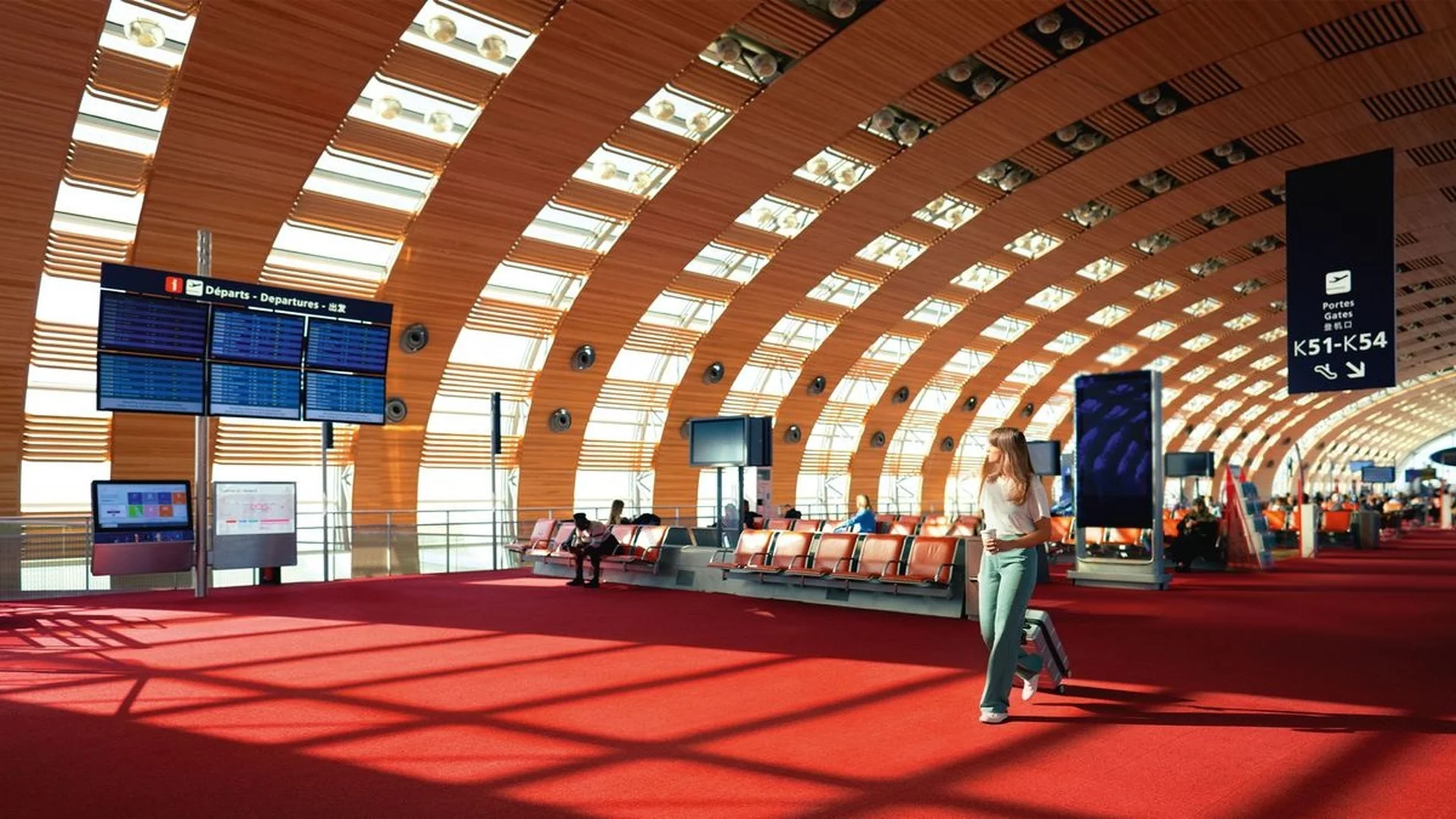
Paris Charles de Gaulle feels less like a building and more like a set from a 1970s science fiction film. Paul Andreu, the architect who designed Terminal 1, understood that an airport should be a disruption of the earth. He built a circular concrete planet and laced it with transparent plexiglass tubes that carry travellers through the air, suspended above a central void.
Charles de Gaulle is an experiment in movement. The experience is designed to be cinematic: you do not simply walk to a gate, you are funnelled through light-filled tunnels and deposited into satellite docks. It is a building that demands your attention. It does not try to fade into the background with beige carpets and acoustic tiles.
This is the airport that decided a terminal should be a circle because a circle has no end. It is the airport that put a museum-grade art gallery in the transit zone and a triple-Michelin chef in the departure hall. In Paris, even a layover is an opportunity for a spectacle.
If you are connecting through Europe and have the choice, route through here. Add an hour and use it inside the buildings.
You will get lost.
You will not mind.
CDG's signature is the Camembert. The affectionate nickname for the circular central building of Terminal 1: a brutalist drum that did not copy any airport that came before it when Paul Andreu opened it in 1974. From the outside a crown of raw concrete. From the inside, something no other airport on earth has attempted before or since.

A seven-storey void, open to the sky at the top, ringed by plexiglass tubes. The tubes are transparent escalator shafts that crisscross the atrium, suspending passengers in mid-air between levels, visible to everyone below. The concrete drum is cut through with these diagonal glass spines, and the effect from the atrium floor is of a building that has been designed from the inside out. Andreu understood that movement itself is the spectacle. He built the architecture around it. Take the free CDGVAL shuttle from Terminal 2 and go inside before any flight. You do not need a boarding pass to stand in the central void and look up into the tubes from below. No other airport on earth has built anything like it since.
The theater extends to the Espace Musees in Terminal 2E: a revolving gallery hosting original works from the Louvre and the Centre Pompidou, free to any passenger in transit. You can stand within arm's reach of a Rodin sculpture while waiting for a flight to Shanghai. In Terminal 2F, two glass-walled piers allow you to sit at a cafe table and watch the ground crews work directly beneath your feet. No opaque wall between you and the tarmac.


The secret to eating well at Charles de Gaulle is understanding that the French do not believe airport food should be a compromise. You do not look for a sandwich. You look for a dining room.
In Terminal 2E Hall L, find I Love Paris by Guy Martin. Martin is a triple-Michelin-starred chef, and this venue was designed to replicate the interiors of the Palais Royal. You are not eating in a terminal. You are eating in a jewel box of teal velvet and gold leaf. Order the blanquette de veau or the classic pot-au-feu. It is a better meal than you will find in most European city centres, and it is airside.
For a faster experience, find the Eric Kayser boulangeries across the terminals. Buy a fresh croissant. The outside shatters when you bite it, not crumbles, shatters. Layered, elastic, slightly sweet. Three euros. You remember it for years. A coffee from the Daily Monop alongside it costs two euros more and is strong, unapologetic espresso.
For a drink, the 8022 bar in Terminal 2E Hall M takes its name from the distance in kilometres between Paris and Tokyo. The focus is champagne and cocktails served in a space that feels like a private club. A glass of Moet is eighteen euros. It is the correct way to end a long journey or begin one.
Before leaving Terminal 2E, buy a vacuum-sealed wedge of AOC-certified Comte from the Les Halles fromagerie. Carry it home. Open it three days later. It still smells like the Jura mountains.
Here is what the seasoned Paris traveller knows that you do not.
First: the museum shortcut. Most travellers in Terminal 2E rush toward their gates without realising that Hall M contains a legitimate branch of the Parisian museum system. Espace Musees is airside, free, and features a rotating exhibition of genuine masterpieces. It is the quietest place in the airport.
Second: the RER B fare from CDG to central Paris is fourteen euros as of 2025, loaded onto a Navigo Easy card or your phone. Gare du Nord in around twenty-five minutes on the fast service, Chatelet in thirty-seven. Always check the destination board before boarding: the B5 branch terminates at Mitry-Claye and does not serve the airport. You want the train marked Aeroport Charles de Gaulle 2 TGV. Taxis run fixed rates: fifty-six euros to the Right Bank, sixty-five to the Left. Take the train.
Third: Terminal 1 is free to enter before security and accessible from any terminal via the CDGVAL. The central void with the tube escalators is landside. You do not need a boarding pass to stand inside Andreu's circular drum and look up through the glass tubes at the crossing escalators above you. This is one of the great interior spaces in world architecture. Twelve minutes on the CDGVAL from Terminal 2. Worth the detour before any flight.
Fourth: the CDG Express direct rail line from Paris city centre to the airport is scheduled to open in 2027. It will change the transport calculation entirely. Until then, RER B is the answer.
Charles de Gaulle solves the layover through two things: a free room designed to feel like a Parisian apartment, and a hotel directly above the train station.
The Instant Paris lounge in Terminal 2E Hall L is free for all transit passengers. Not a traditional lounge: a series of interconnected rooms designed to feel like a large Parisian apartment. Communal wooden tables for working, velvet sofas for reading, dimmed lighting, controlled noise. It is the most effective piece of non-commercial architecture in the airport.
For families, the Gulli play areas in Terminal 2E are interactive zones with touch-screen games, positioned near seating so parents can watch their children. For sleep, YotelAir in Terminal 2E operates twenty-four hours airside: proper beds, bookable from four hours, no immigration required. The Sheraton sits directly above the TGV and RER station in Terminal 2. You step off the train and walk to your room, or walk from your room to the train.
The Air France salons in Terminal 2E carry Clarins spa treatments and a hot buffet that outclasses almost any other airline lounge in Europe. Day passes are sometimes available if space permits.

You have two hours. Or four. Or eight. Or thirteen. Here is what to do.
Stay airside. CDGVAL to Terminal 1. Ride the tube escalators through the Camembert void. Espace Musees. Kayser croissant back in 2E. Buy the Comte.
Still airside. Instant Paris lounge for an hour. I Love Paris by Guy Martin for lunch. Hall M for the 8022 bar. Hall L art installation.
RER B to Gare du Nord, twenty-five minutes. Walk the banks of the Seine. Notre-Dame, reopened December 2024. Steak frites in the Latin Quarter. Train back.
RoissyBus to Opera. Musee de l'Orangerie for Monet's Water Lilies. Louvre courtyard. Dinner in a bouillon in the 1st: loud, fast, correct. RER back. Sleep on the flight.
The RER B reaches Gare du Nord in twenty-five minutes for fourteen euros. The RoissyBus takes one hour and costs sixteen euros. Taxis run fifty-six euros fixed to the Right Bank. Take the train.
Paris's photograph is the central void.
Take the CDGVAL to Terminal 1. Walk to the lowest level of the Camembert atrium and look straight up. The circular concrete walls rise like a fortress while the transparent tubes cut across the sky in a geometric lattice. Switch to 0.5x wide angle. Point the 0.5x so the circular opening of the roof is at the centre. Other passengers are moving through the tubes above you.
This is the photograph that captures the Space Age ambition of the seventies. Nothing about it reads as a conventional terminal. The Camembert looks like a vision of the future that actually got built. Andreu designed it in 1974 and it is still fifty years ahead.