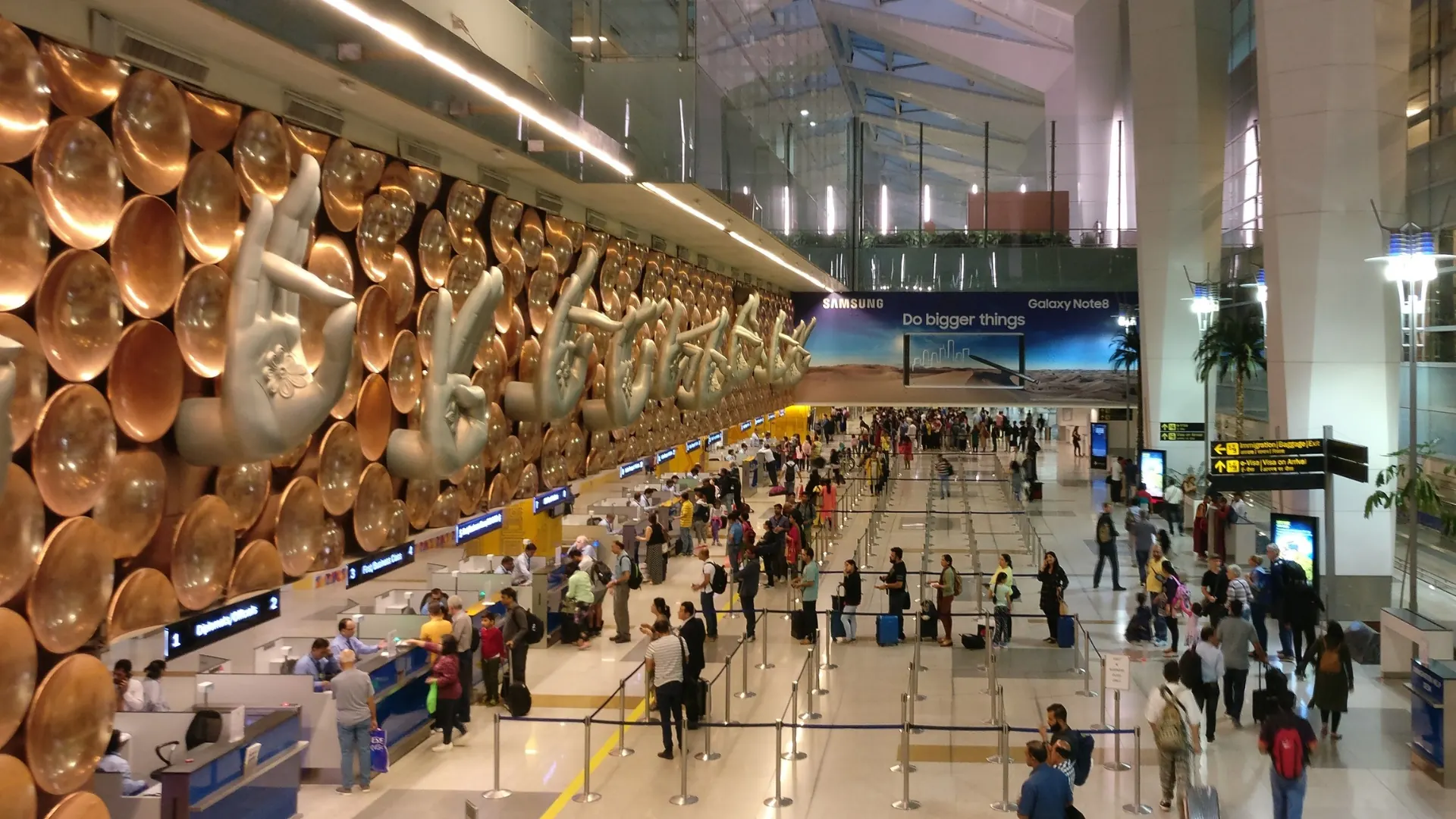
A decade ago, Delhi's Indira Gandhi International Airport was not in the world's top ten. In 2024, it handled 77.8 million passengers and ranked ninth, behind Atlanta, Dubai, Dallas, Tokyo, London, Denver, Istanbul, and Chicago. That is not a growth statistic. That is a country rearranging itself.
Delhi did the opposite. It kept the Canyon Wall of Mudras at the entrance, the Surya in the departure pier, the Husain mural over the check-in hall. It added a fourth runway, built India's first elevated cross-taxiway, and installed a facial-recognition boarding system that clears security in under a minute.
This is the airport that was told to scale, and refused to look industrial while doing it. The brief written for T3 in 2010 was called Expressive India, and every choice since has been a consequence of that brief.
If you are connecting through Asia on a long-haul route, Delhi is now a viable alternative to Dubai. Allow three hours on international arrival. The customs queue is still the slowest thing about the airport.
Ancient mudras at the door.
A modern superpower taking flight.
Delhi's signature is the Canyon Wall.
Two hundred and forty metres of bronze-and-copper-finished wall at the T3 entrance, dotted with nine hand gestures from Indian classical dance and yoga. The mudras were rendered by Jaipur-based designer Ayush Kasliwal in 2010, each hand two-and-three-quarter metres tall, modelled on a female hand in the style of Chola bronzes. Six hundred and seventy-five copper-plated aluminium discs flank them, each spun by hand. Nine gestures repeated across twenty-four installations. Every arriving passenger walks past it. Almost nobody photographs it quickly enough.

The Canyon Wall is only the opening statement. Deeper inside T3, past immigration at the International Departures pier, a twelve-foot Surya stands in copper with gold-plated inlays. Satish Gupta modelled it on Chola temple bronzes. It is the figure you pass before boarding a Delhi-to-London flight, and it is not accidental that it is the last thing you see.
In Terminal 1, a Cheriyal scroll painting by Sai Kiran Dhanalakota tells the Ramayana across an entire wall. Cheriyal is one of Telangana's oldest art forms — natural pigments on khadi cloth treated with tamarind paste, bold outlines, horizontal panels, each scene a self-contained episode from the epic. Sai Kiran carries the tradition of the Dhanalakota family, one of the last practising Cheriyal lineages. The scroll unrolls the story of Rama from exile to coronation. You walk past it on your way to the gate, and the airport becomes a museum that happens to have runways.
Near the domestic departure zone, Delhi Bazaar brings the old city inside the terminal. Hand-woven Pashmina shawls from Kashmir, single-origin Darjeeling first flush in wooden caddies, Rajasthani leather puppets, sandalwood carvings. It is open around the clock. You do not need to leave the airport to carry India home with you.


The thing to know about eating at Delhi airport is that the signature dish of the entire city was invented inside one restaurant in 1947, and that restaurant has a branch inside T3.
Butter chicken was created at Moti Mahal in Daryaganj, old Delhi, in 1947 by the three Peshawar refugees who founded the restaurant after partition. Tandoori chicken reworked in a tomato-and-cream gravy, designed to use up the previous day's leftovers. It is now the single most exported Indian dish on the planet. Moti Mahal Delux, the modern chain, operates inside T3 International Arrivals. The butter chicken is the right order. The tandoori chicken is also the right order. If you have never had either, this is the place to start.
For a more casual meal, Dhaba @ T3 in Domestic Departures serves dal makhani, tandoori breads, and Punjabi thali in a reconstructed highway-dhaba setting. Street Foods by Punjab Grill does kebabs and matka dum biryani. Dilli Streat, also in Domestic Departures, covers the street-food end: chaat, kulche, chole. Carnatic Cafe handles South Indian with fresh dosas and filter coffee.
Pricing runs high across the board. The Domestic food court in T3 is consistently cheaper than the International side for the same dish at the same chain. Most outlets stay open twenty-four hours, but confirm individual hours at the information desk if your layover is past midnight.
For the drink, skip Starbucks. Find Chaayos in T3 Domestic Arrivals and order a kulhad chai. Masala chai served in a baked-clay cup that you keep or discard. Five hundred rupees gets you two, with a samosa and a vada pav thrown in.
Here is what the seasoned Delhi traveler knows that you do not.
First: DigiYatra. Indian citizens with an Aadhaar card can link their face to their boarding pass through the DigiYatra app, then walk into T3 through Entry Gate 2A, past pre-security, and onto the aircraft at Gate 27 or 39 without ever showing a document. The savings on a peak-hour day run to forty-five minutes. It is free. Domestic only. No foreign passport support yet.
Second: city check-in at New Delhi Metro Station. If you are flying Air India on a domestic route, you can drop your bags and collect your boarding pass at the New Delhi station of the Airport Express Line, between six hours and two-and-a-half hours before departure, then ride the Orange Line to T3 unencumbered. International city check-in was paused during COVID. Worth checking the day of travel.
Third: CAT IIIB in the fog. Between November and February, Delhi produces some of the densest fog on the commercial aviation map. The airport runs a Category IIIB Instrument Landing System that allows landings at fifty metres of visibility, and a predictive fog model that calls dense fog thirty-six hours out. Your flight will still be delayed, because not every aircraft or pilot is CAT IIIB certified. Budget two extra hours into any winter connection through Delhi.
Fourth: the Eastern Cross Taxiway. India's first elevated taxiway, opened in July 2023, runs over the T3 access road. It cuts the taxi distance from the new runway to Terminals 1 and 2 from nine kilometres to two. Fifteen to twenty minutes shaved off your on-aircraft time after landing. You cannot see it from inside the terminal. You will feel it on the ground.
Delhi does not have a quiet hour. The terminal runs at full tilt at 3am — flights boarding, food courts open, staff moving. The city that never sleeps built an airport to match. Every layer of comfort is available around the clock, from free to flagship.
For free sleep, T3 International has a Quiet Room on Level 4 near Gate 15 with cushioned chairs and recliners. Lounge-style seating clusters near Gates 27 and 28. Security may redirect floor-sleepers to the carpeted zones. For paid sleep, Infinity Sleeping Pods opened twenty private pods across three T3 locations in 2024, bookable by the hour, single or double occupancy, full-length bed and charging. The Holiday Inn Express transit hotel at T3 offers airside rooms by the hour or the night.
For families, the children's play area sits airside at T3 International Departures. Baby-care and nursing rooms operate at all three terminals. Complimentary strollers are available at every information desk. Neither facility is well signed, but both exist and both are free.
For the business traveler, Air India opened the flagship Maharaja Lounge at the T3 International pier in February 2026. Sixteen thousand square feet, designed by Hirsch Bedner Associates, with an Aviator's Bar whose ceiling echoes the propeller of J.R.D. Tata's 1932 Puss Moth. Access is First and Business Class only. Plaza Premium and Encalm also operate on Priority Pass at T3, with walk-in rates around two-and-a-half thousand rupees for four hours.

You have two hours. Or four. Or eight. Or thirteen. Here is what to do.
Stay airside. Walk T3 International. Surya at the pier. Kulhad chai from Chaayos. Butter chicken at Moti Mahal Delux. Return to gate with Delhi in your head.
Shower and nap at the Maharaja Lounge or Plaza Premium. Thali at Dhaba @ T3. Walk both piers to see the Maity mural, the Husain, and the elephant sculptures. T3 is big. Give yourself the time to look at it.
Orange Line to Aerocity, one stop, fifty rupees. Lunch at Pullman. Or taxi to Qutub Minar for ninety minutes at the UNESCO site. Return with two hours of buffer.
Humayun's Tomb. Lodhi Garden. Moti Mahal Daryaganj for the original butter chicken. India Gate at dusk. Orange Line back. A day trip squeezed out of a connection.
The Airport Express Line runs to New Delhi station every ten to fifteen minutes for around sixty rupees. Nineteen minutes. The fastest metro in India. A prepaid taxi to Connaught Place is six to seven hundred rupees. Uber pickup is inside the multi-level parking at Lanes 2 and 3.
Delhi's photograph is a single mudra on the Canyon Wall.
Stand ten metres back from the wall, on the landside approach between domestic arrivals and departures. Frame Abhaya, the gesture for fearlessness. Switch your phone to 0.5x wide angle. The six hundred and seventy-five copper discs fall away on either side, receding into the bronze field.
This is the photograph that tells you, without words, that you have arrived in India. Not a flag, not a monument, not a Taj silhouette in the duty free. Just a hand, held up to greet you. A country introducing itself in the oldest language it has.
