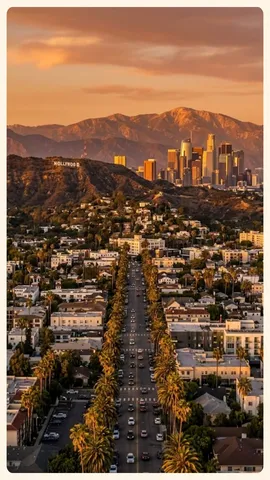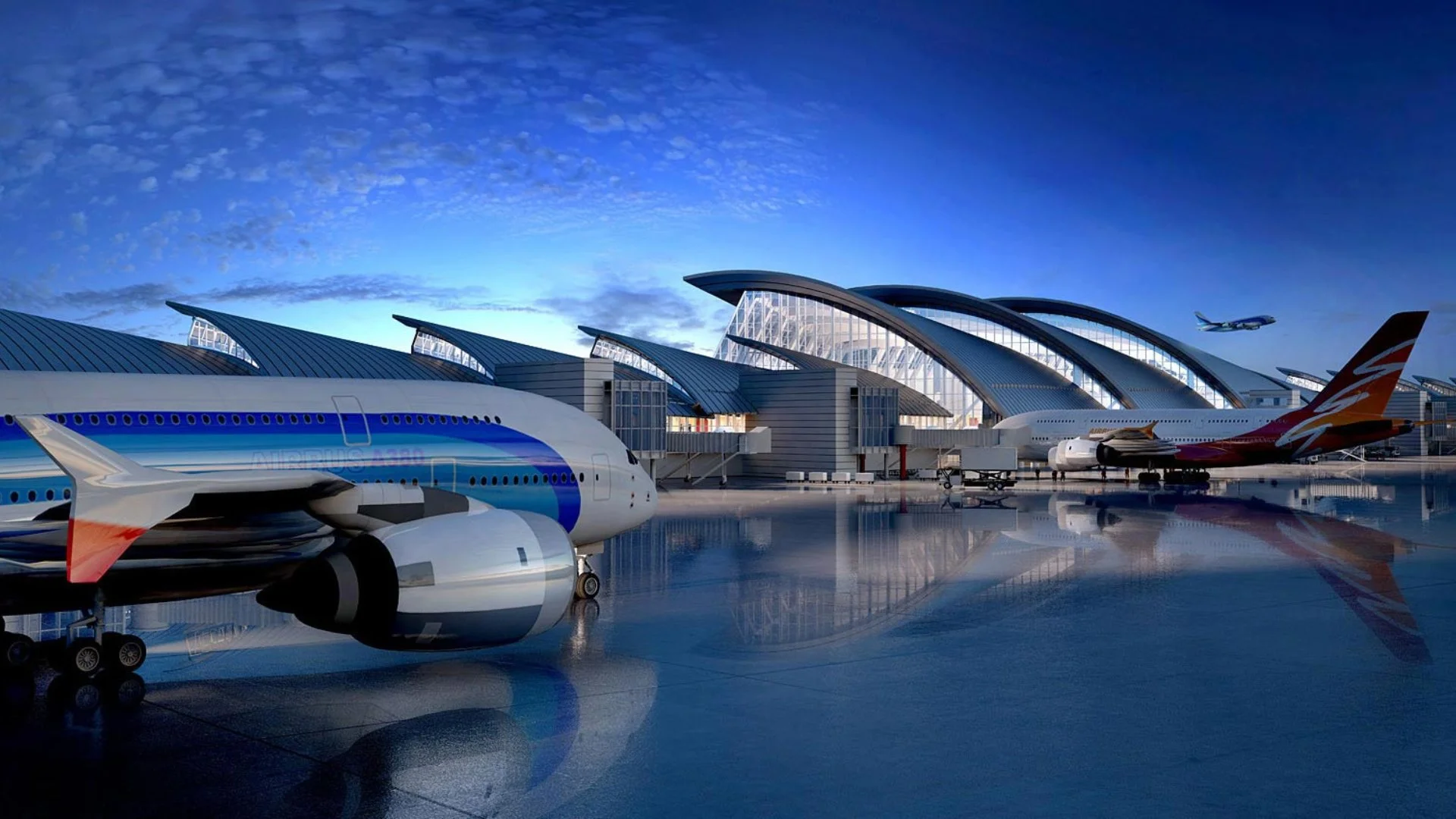
Los Angeles is the end of the American frontier. Westward expansion ran out of land at the Pacific. The city grew where the continent stopped, became the country's window to Asia, and inherited the Pacific routes that no eastern city could claim. LAX exists because the geography ran out.
The X in LAX means nothing. Planners added it in 1947 when two-letter codes could no longer accommodate new airports. Los Angeles makes mythology out of accidents. It is the most recognized airport code on earth and it stands for nothing.
LAX is not a hub in the way Chicago or Atlanta is a hub. Eighty-eight percent of passengers begin or end their journey here. They do not connect. They arrive. They leave. The world's busiest origin-and-destination airport is not a waypoint.
Nine terminals form a horseshoe. Tom Bradley International Terminal anchors the western end, handling routes to more Asian capitals than any other airport in the western hemisphere. You are standing at the Pacific end of the American story.
Every dream has a gate number.
This is where they land.
The first thing you see after landing internationally at LAX is Pae White's ΣLAX. Above the sterile corridors leading to customs: 23.86 miles of custom-dyed cordage strung through 7,484 gold brackets. Eleven are actual 14K gold. The three color palettes echo the ceramic tile mosaics Charles D. Kratka installed in the original terminals in the 1960s. A conversation across sixty years of airport design, running the length of the arrival hall.
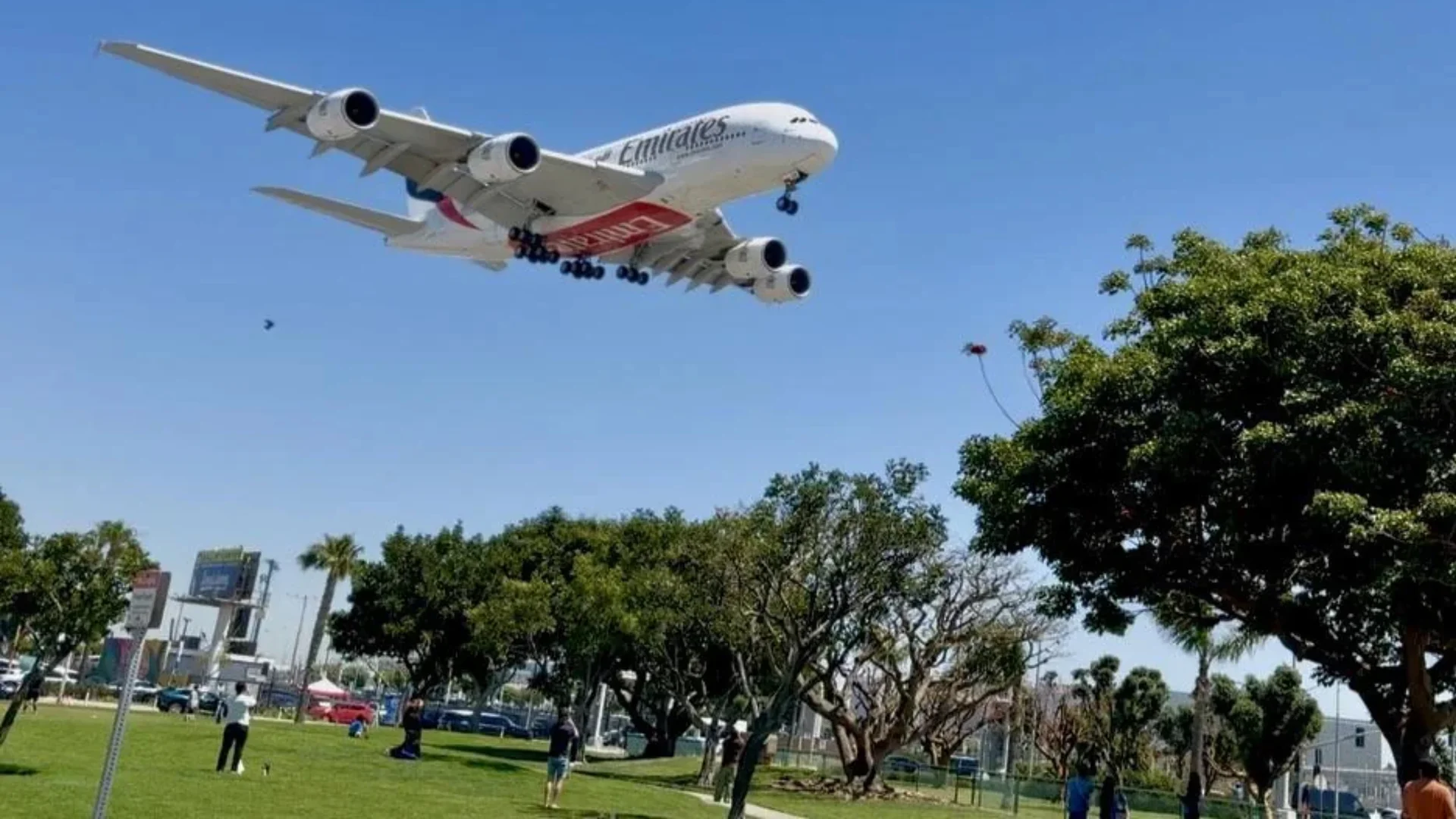
For the best seat in the house, leave the terminal. At 9149 South Sepulveda Boulevard, corner of West 92nd Street, an In-N-Out Burger sits directly under the approach to Runway 24R. Aircraft pass overhead on final. Between eleven in the morning and three in the afternoon, the widebody mix peaks: A380s, 777-300ERs, 747-8s from carriers across Asia, Europe, and the Pacific. Planes are backlit for photography most of the day. Come for the experience. Order the Double-Double.
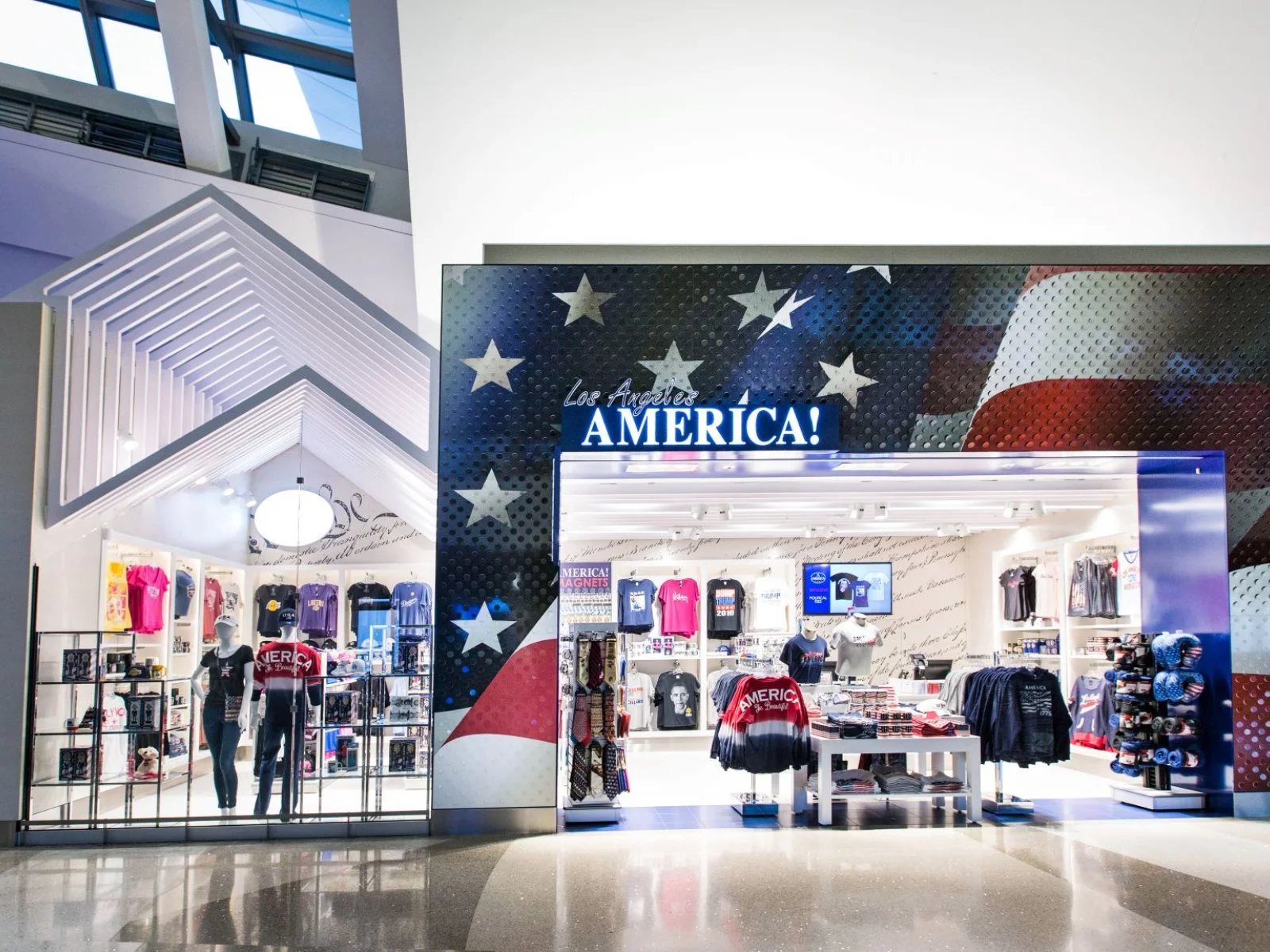
Tom Bradley International Terminal is the last American airport before the Pacific. AMERICA!, in the Great Hall, has stocked the full range for twenty-five years: apparel, pop culture, local pride, current events. See's Candies, at Gate 221 in the West Gates, has been making the gold box in Los Angeles since 1921. It does not exist in meaningful form outside the western United States. If you are flying to Asia or Europe, buy two boxes. People will ask where you got them.
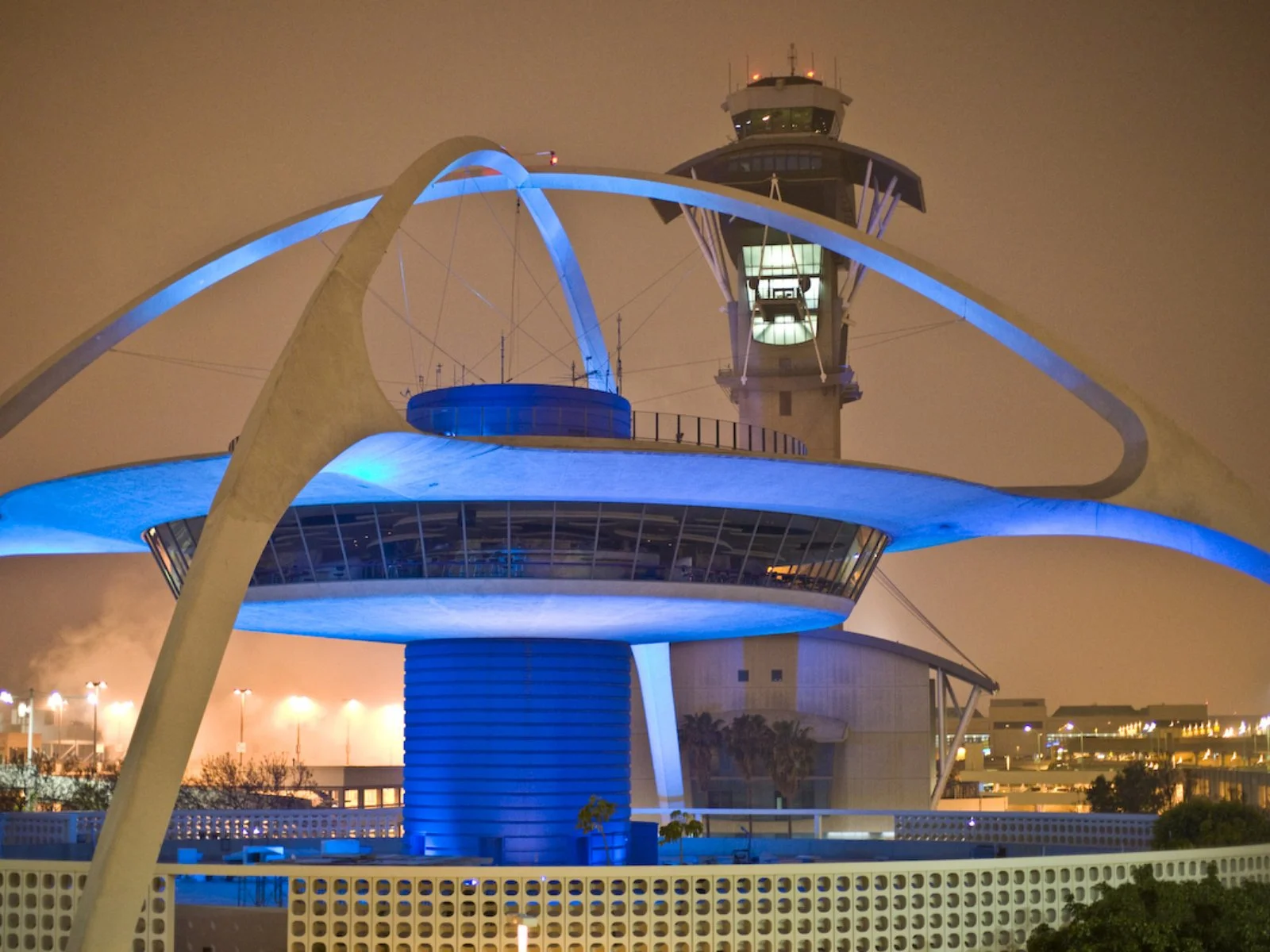
The Theme Building stands at the center of the terminal horseshoe on four intersecting parabolic arches. Built in 1961, designated a Los Angeles historic-cultural monument in 1993, its interior now closed and deteriorating. It is a monument, not a building you enter.
The fundamental problem with eating at LAX is that once you clear security, you are stuck with your terminal. Nine terminals, nine different menus, no crossing over. Check your terminal before you leave the house.
The best meal at LAX is a chicken caesar wrap from Homeboy Cafe in Terminal 3. Homeboy Industries is the world's largest gang rehabilitation and re-entry program, founded in 1988 by Jesuit priest Father Greg Boyle at Dolores Mission Church in Boyle Heights. The cafe is staffed by formerly gang-involved men and women the program has trained and redirected. The chicken caesar wrap is the size of a Nerf football. People buy it because it stands for something. If you are flying Delta, this is where you eat.
In Tom Bradley International Terminal, Border Grill has been open since the terminal reopened in 2013. Susan Feniger and Mary Sue Milliken first opened on Melrose Avenue in 1985, one of the restaurants that made Los Angeles take Mexican food seriously. The LAX outpost is landside, full bar, open from six in the morning. It is the meal before the transpacific flight when you want to eat something that tastes like the city you are leaving.
The Infatuation's 2024 LAX guide is the honest benchmark. Most terminals have one good option and several bad ones. Terminal 1: Urth Caffe. Terminal 2: Barney's Beanery. Terminal 3: Homeboy. TBIT: Border Grill. Everywhere else: manage your expectations.
For coffee, Terminal 7 has Klatch. A Southern California family roaster operating since 1993, now with a roastery in Upland and locations across the region. Not Starbucks. Not Coffee Bean. Order the espresso.
LAX rewards the passenger who has done the research. Most have not. Four things change the experience significantly.
First: all nine terminals are now connected airside, a project completed in 2023. The walk from Terminal 1 to TBIT takes fifteen to twenty minutes. Allow ninety minutes minimum for any domestic-to-international connection. Arriving internationally before a domestic connection adds United States Customs to the itinerary. Allow another forty minutes for that.
Second: the FlyAway bus to Union Station departs from the lower arrivals level of each terminal, runs every thirty minutes, costs twelve dollars and seventy-five cents, and delivers passengers to Union Station in approximately forty-five minutes. More reliable than a rideshare during peak hours. Almost no one uses it.
Third: the Tom Bradley International Terminal has a Star Alliance Lounge on the mezzanine level of the West Gates building. Access requires Star Alliance Gold status or an international first or business class boarding pass on a Star Alliance carrier. The lounge has showers, a full bar, and an outdoor terrace with views of the apron and the Hollywood Hills beyond.
Fourth: the cell phone lot on 96th Street is free, open twenty-four hours, and the correct place to wait when meeting an arriving passenger. Monitor arrivals on the LAX app, then move when the bags are out. The lot is five to ten minutes from the TBIT arrivals exit depending on traffic. Using it instead of circling the horseshoe saves twenty minutes and is the local knowledge that distinguishes an Angeleno from everyone else.
The upper departure concourse of the Tom Bradley International Terminal faces the western apron. This is a public airside space that requires no lounge access. Stand against the glass in the evening and on most nights Qantas and Air New Zealand widebodies are parked within view, preparing for the Pacific crossing.
The Star Alliance Lounge occupies the mezzanine level of the terminal. Access is limited to Star Alliance Gold members and passengers holding an international first or business class boarding pass on a member carrier. Priority Pass is not accepted here. Showers are available. Request one at the front desk on arrival.
The defining element of this lounge is the outdoor terrace. The space operates like a Los Angeles bar with open fire pits and a full beverage menu. You can sit outside with a drink and look across the tarmac toward the Hollywood Hills.
American Express runs a Centurion Lounge in the same building for Platinum and Centurion cardholders. The doors open at six in the morning and close at ten at night. The facility provides hot food service and shower suites. High passenger volumes mean this room frequently reaches full capacity.
LAX releases into a city with no center and no single axis. The direction you move depends entirely on how much time you have.
Sepulveda Boulevard south to Manhattan Beach. Fifteen minutes without traffic. Park at the pier and walk the strand south toward Hermosa. The Pacific is to your right. The view does not change between here and Tokyo, which gives you a sense of the crossing ahead.
Venice. Abbot Kinney Boulevard is one mile of independent restaurants, bookshops, and galleries fifteen minutes from the airport. Gjusta at 320 Sunset Avenue makes the bread Angelenos are most likely to mention unprompted. It opens at 7am. The pastries run out by 10.
Getty Center. Richard Meier's hilltop campus above Brentwood, reached by free tram from the parking structure. Van Gogh's Irises is in the West Pavilion. Entry is free. Parking is twenty-five dollars, fifteen after 3pm. The garden terraces face Santa Monica Bay. The building opened in 1997.
Griffith Observatory. The 1935 building on the south face of Mount Hollywood. Open Tuesday through Friday from noon, Saturday and Sunday from 10am, all nights until 10pm. The terrace faces south and west: the LA grid, the Pacific on clear evenings. The Hollywood sign is behind you up the hill.
Metro K Line from the LAX/Metro Transit Center connects to downtown via transfer at Expo/Crenshaw. FlyAway buses serve Union Station and Van Nuys from the lower arrivals level of each terminal. Rideshare loads at the LAX-it lot, reached by free shuttle from any terminal.
The photograph that captures LAX is not taken inside a terminal and not taken from a gate.
Stand at the central plaza between Terminals 3 and 4, facing the Theme Building. The structure is forty feet above the road on four curved concrete legs. To the west: TBIT and the Pacific routes. To the east: the domestic horseshoe. Straight ahead: the northern runway complex and the ocean approach path. At dusk the concrete catches orange light. A plane crosses the frame approximately every ninety seconds on final approach.
Use the 0.5x lens. The frame holds a curved leg of the Theme Building in the foreground, an aircraft in the middle distance on approach, and the runway lights beginning to come on behind it. This shot requires patience and a clear day. Los Angeles has three hundred clear days a year. The plaza is free, always open, and no one is looking at it. They are all inside watching the departures board.