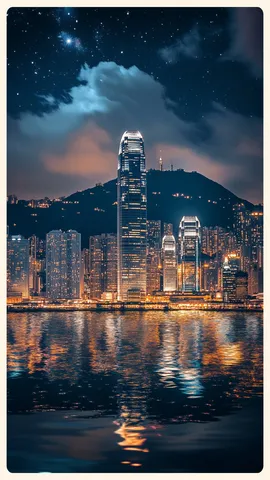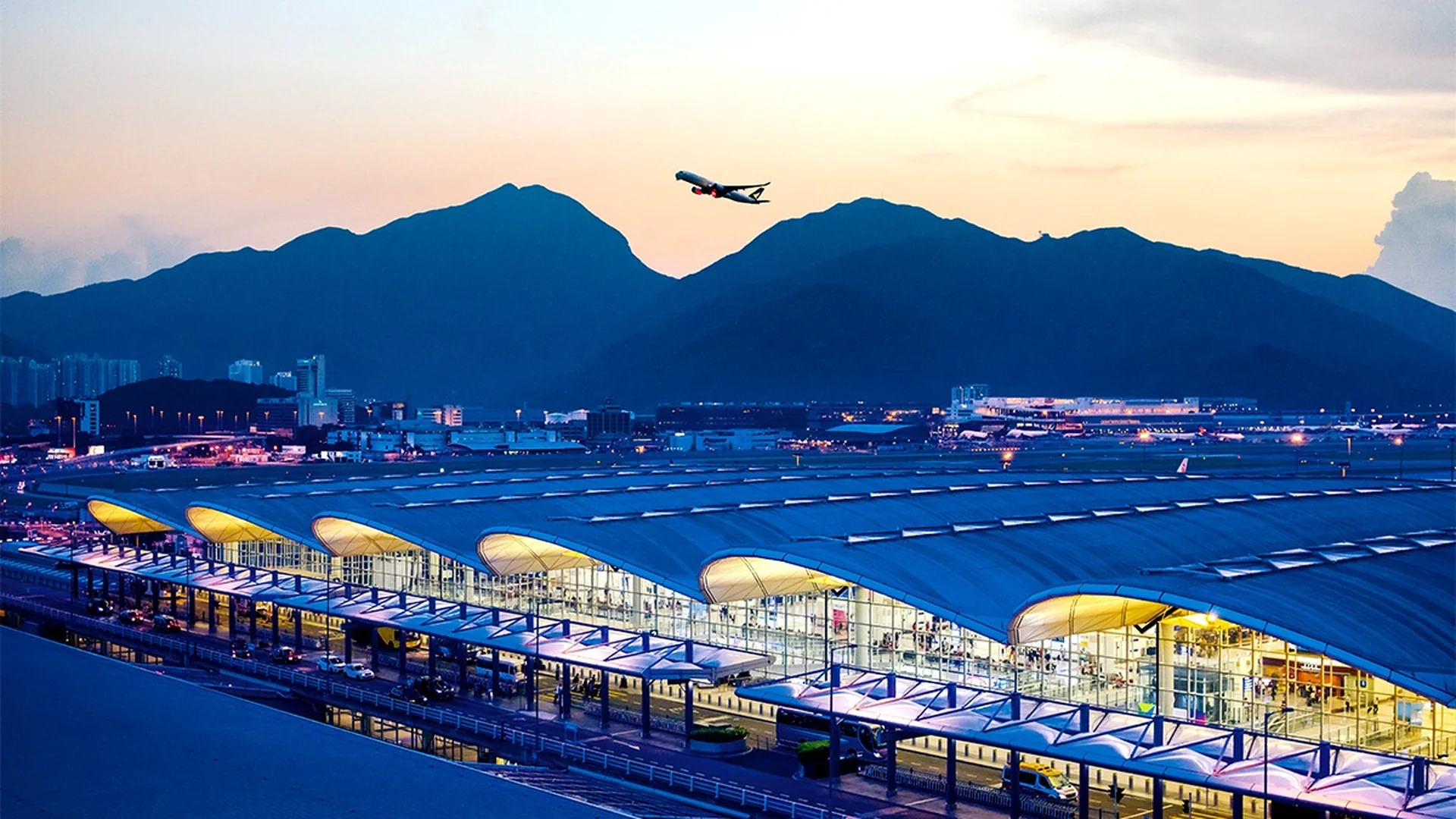
Hong Kong International is the most ambitious airport construction project ever completed. To build it, an entire mountain was quarried flat. Two islands were fused with reclaimed land. And on the night of 5 July 1998, the entirety of the old Kai Tak Airport's operations was relocated to the new facility in a single overnight move. Kai Tak was famous for its white-knuckle approach between Kowloon apartment blocks, where pilots descended at forty-seven degrees to the runway. In a few hours it was silent forever.
Opening in the immediate wake of the handover to China, the twenty-billion-dollar project was a definitive statement about Hong Kong's future. Norman Foster's soaring vaulted hall, with its Y-shaped columns and continuous translucent roof, set the standard for every large-span terminal built since. Twenty-eight years later, the architecture still reads as the work of someone who understood the airport of the future before anyone else had finished describing it.
The defining quality of Chek Lap Kok is speed. Immigration takes minutes. The Airport Express reaches the city in twenty-four. The cargo operation is the busiest on the planet by tonnage. This is not an airport that asks you to wait. It moves.
If you are transiting through Asia and want to leave the terminal, Hong Kong is the only major hub where a four-hour layover is genuinely viable. The maths work. Use them.
An island reclaimed from the sea.
A gateway reclaimed for Asia.
Hong Kong's signature is the hall itself.
Norman Foster's terminal is defined by massive Y-shaped columns supporting a vaulted roof that floods the concourse with daylight while deflecting the subtropical heat. Floor-to-ceiling windows frame the South China Sea, with Lantau Island's mountains rising sharply behind. The architecture does not try to add drama on top of its engineering. The engineering is the drama: a building that covers enough ground to contain the entire city of Monaco, organised so simply that you know where to go from the moment you step inside.
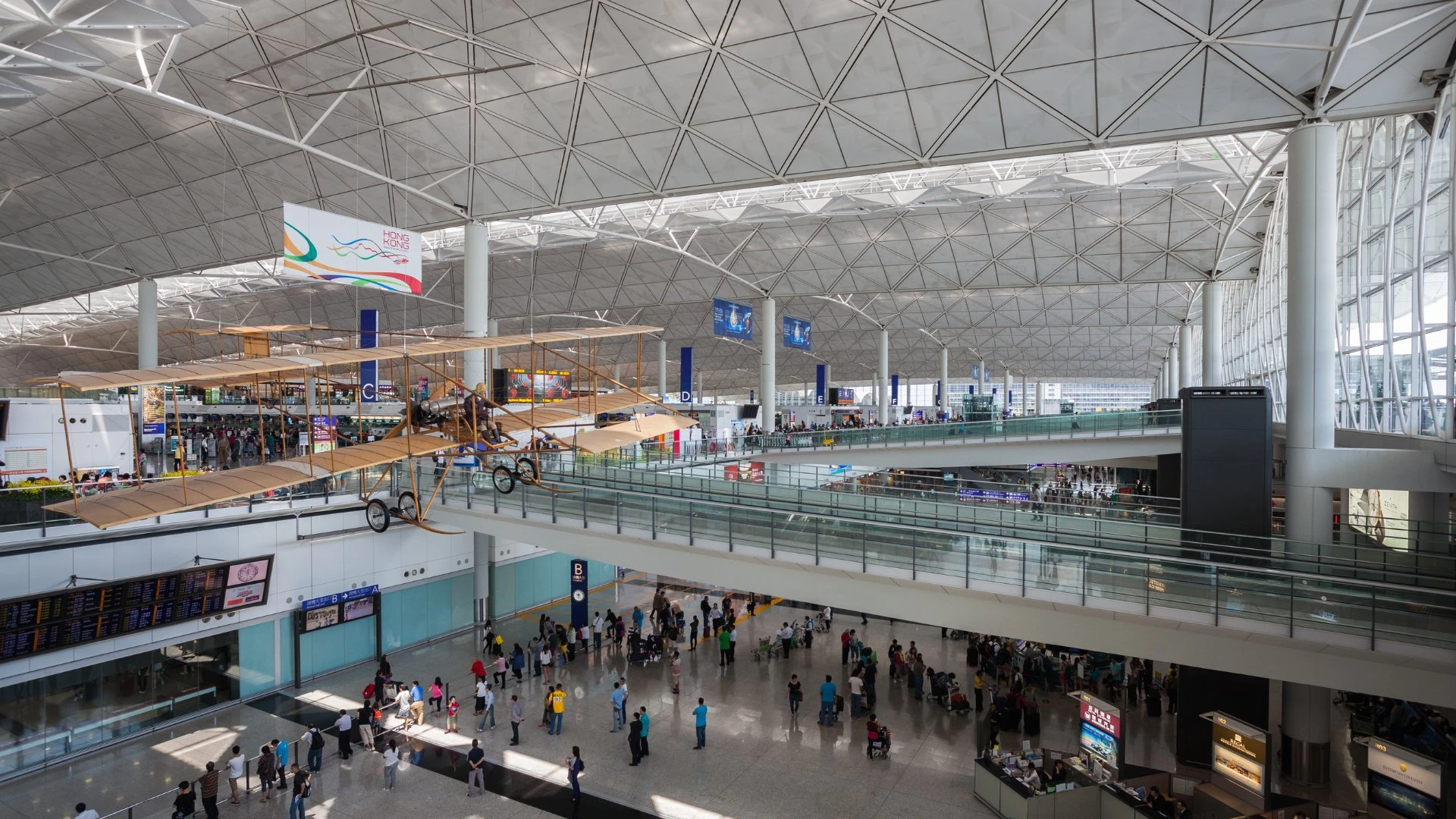
Suspended from the concourse ceiling, a full-scale replica of the Farman biplane that Charles Van den Born flew over Sha Tin in 1911, the first recorded powered flight in Hong Kong. One hundred and fifteen years of aviation history, hanging above your head in the terminal that replaced it all. The symbolism is not subtle, and it does not need to be.
The SkyBridge, the world's longest airside passenger bridge, arcs over an active taxiway. Aircraft pass directly beneath you as you walk. At the far end, the Midfield Concourse and its automated people movers extend the terminal's reach into reclaimed land over the water, with panoramic views of the approach path from the waiting gates.
At the rooftop aviation garden on Terminal 1, outdoors and free, you stand above the taxiway with a direct view of the movements below. Most of the passengers inside do not know it is there.


You are in Hong Kong. The food here is not a concession to travellers. It is a cultural position, and the airport maintains it.
Duddell's on Level 7 is a casual outpost of the Michelin-starred restaurant in Central. The airport kitchen runs the same operation: dim sum steamed and roasted on site, barbecued meats carved to order, stir-fries sent out at pace. It is the only Michelin-starred dim sum kitchen operating airside at any major hub in the world. The char siu is the thing to order first.
Yung Kee at Level 6 carries the roast goose that made it a Central institution: charcoal-grilled, dark-lacquered, the preserved century egg on the side. The recipe has not changed. A few gates along, Men Wah Bing Teng is the bing sutt in its proper form, tracing back to a Kowloon counter from the 1970s. BBQ pork with egg and rice, sa cha beef noodles, and the silk-stocking milk tea that people mean when they say Hong Kong milk tea. Open around the clock. The jolt required to cross the Pacific.
For coffee, %Arabica near Gate 10 on Level 6 is the Kyoto specialty chain that has been in Hong Kong since 2017. The kyoto-style latte is worth the detour. For a drink with a longer view, INTERVALS on Level 9 sits on the Skybridge between the main terminal and the Satellite Concourse, twenty-eight metres above the apron. Cocktail flights, pinchos, a direct sightline over the active runway. No other bar at any hub airport is positioned like this one.
Here is what the seasoned Chek Lap Kok traveller knows that you do not.
First: in-town check-in. You drop your bags at a counter in Hong Kong Station in Central, or at Kowloon Station, receive your boarding pass, and walk out into the city completely unburdened. Your bags travel separately to the terminal and wait for you at your final destination. You get hours of Hong Kong with nothing heavier than a daypack. No other hub airport in the world offers this at the same scale and reliability.
Second: the SkyPier. You can board a high-speed ferry from directly inside the terminal to Macau, Shenzhen, or Zhuhai without ever clearing Hong Kong immigration. The ferry pier is landside, linked to the terminal by a walkway. For passengers connecting to the Pearl River Delta, this is faster than any alternative and entirely invisible to most people who walk past the signs.
Third: the rooftop aviation garden. On the roof of Terminal 1, an outdoor terrace gives a direct sightline to the taxiway movements below. Free to access, perpetually uncrowded, and offering views that the spotters in the concourse below would pay for. Take the escalator up and follow the signage.
Fourth: the Airport Express pre-clearance. US-bound passengers on eligible flights can complete US immigration and customs at the in-town check-in counters in Kowloon or Hong Kong Station before boarding the Express. You arrive at the departure gate in the US as a domestic-style connection. The queue is a fraction of the length it would be on the US side.
Hong Kong's transit infrastructure is built around the premise that speed is a form of hospitality. The Airport Express is so fast that a four-hour layover grants genuine access to the city. But if you stay, the terminal provides.
For sleep, the Regal Airport Hotel connects directly to the arrivals hall via an enclosed walkway. No shuttle, no weather. Rooms available by the hour or by the night. The hotel pool overlooks the active runway, which is either relaxing or distracting depending on your relationship with aircraft. The Aerotel airside offers micro-stays for transit passengers who do not want to clear immigration.
For families, the terminal has a dedicated children's play area near Gate 1 on Level 7. The SkyCity development adjacent to the terminal adds retail and dining options with a separate feel from the concourse. Baby care rooms are available on both levels of both the main terminal and the Midfield Concourse.
For the business traveller without Cathay lounge access, Plaza Premium operates the most extensive network of pay lounges in the terminal: three locations, all with hot food, private shower suites, and reliable Wi-Fi. Priority Pass is accepted. The Plaza Premium in the Midfield Concourse is the best-designed of the three and the least crowded.

You have two hours. Or four. Or eight. Or thirteen. Here is what to do.
Stay airside. Dim sum at Duddell's on Level 7. Walk the Skybridge to INTERVALS for runway views. Milk tea at Men Wah Bing Teng. Rooftop garden if time allows. Return to gate.
Airport Express to Hong Kong Station in twenty-four minutes. Ride the Mid-Levels escalator. Buy an egg waffle from a street vendor in Central. Star Ferry across Victoria Harbour. Express back.
Express to Central. Double-decker tram to Wan Chai. Michelin-starred dim sum at Tim Ho Wan. Sheung Wan and PMQ. Star Ferry to Kowloon. Walk Temple Street Market. Express back.
Express to Kowloon. Peak Tram up Victoria Peak. Late lunch in Soho. Star Ferry at sunset. Mong Kok night markets. Express back. Shower at the airport. Board feeling like you visited a city.
The Airport Express runs every ten minutes. Twenty-four minutes to Hong Kong Station for HKD 115. Taxis take longer and cost more. The Express is always the right answer, and the in-town check-in at Kowloon or Hong Kong Station is always worth using if you have the time to set it up.
Hong Kong's photograph is the departure.
Walk to the farthest gates in the south concourse. Face the floor-to-ceiling glass. Switch to 0.5x wide angle. Frame the exact moment a Cathay Pacific A350 rotates off the tarmac, its nose lifting against the sheer, mist-green verticality of Lantau Peak rising directly behind the runway, the South China Sea spreading away to the left.
This is the photograph that does not look like an airport. Mountains, sea, and machine. The compression of geography that makes Hong Kong what it is: a city that built itself into a vertical landscape and then figured out how to leave it at five hundred knots.