Bangkok Suvarnabhumi feels like a metropolis under glass. It is not because the terminal covers over half a million square metres. Every major aviation facility manages scale. It is because Suvarnabhumi was designed by Helmut Jahn to look like a machine breathing in the tropics. He stripped away the opaque concrete walls and replaced them with a translucent canopy of steel and fibreglass.
Suvarnabhumi does not hide what it is. Bangkok amplifies it. The experience is industrial and atmospheric. You walk down seemingly endless metallic corridors while the harsh Thai sun is filtered into a cool, diffused glow. It is a building that uses the climate rather than fighting it.
This is the airport that decided to build a twenty-three-kilometre bicycle track around its runways and place giant mythical guardians in the check-in hall. In Thailand, massive scale and ancient tradition must coexist. When you land here, you do not feel like you are nowhere. You know exactly where you are.
If you are connecting through Southeast Asia, route through here. Add time and use the building.
A canopy of steel and light.
Built to shelter you.
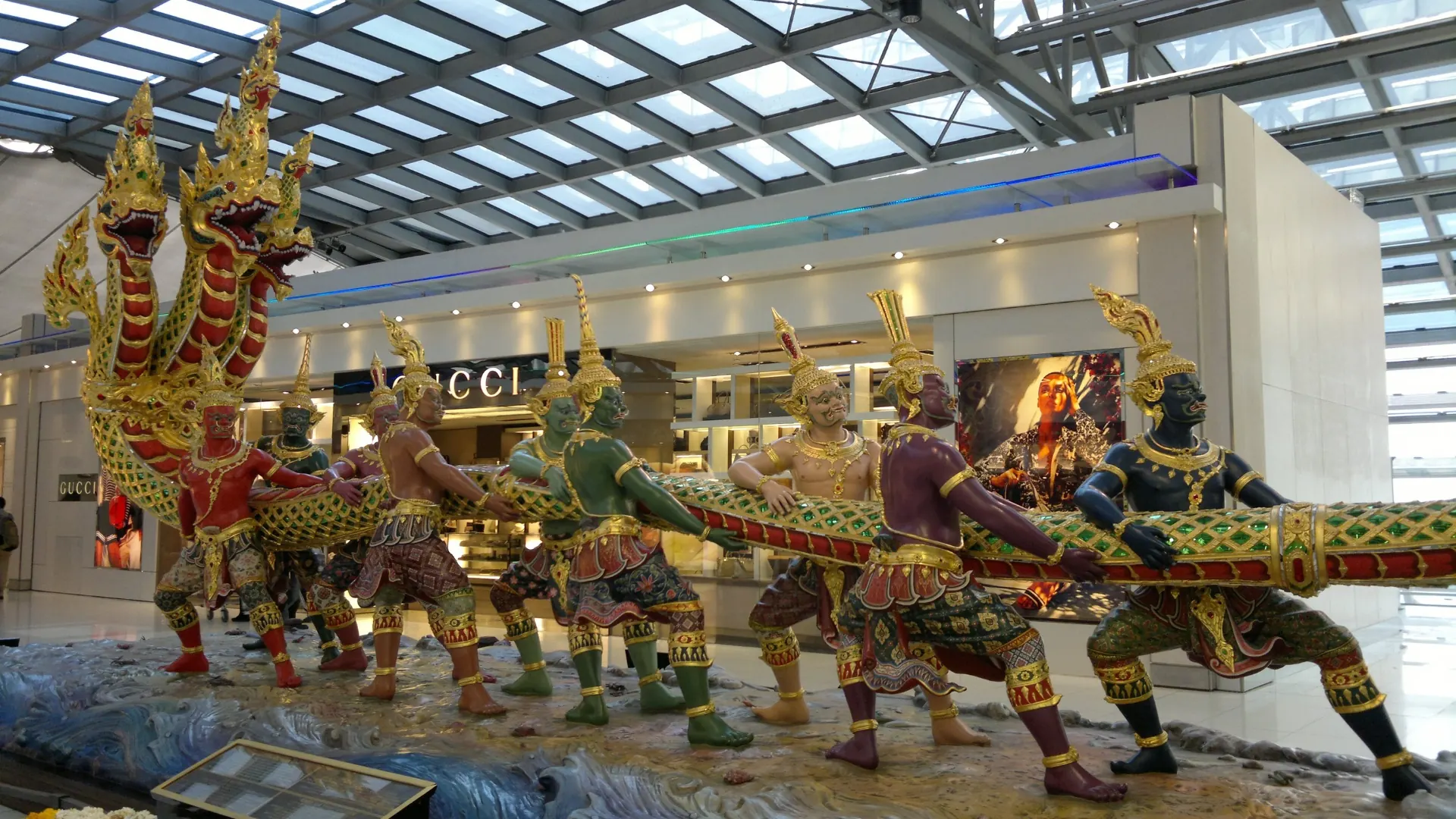
Bangkok's signature is the Samudra Manthan.
Dominating the Level 4 intersection past passport control is a colossal sculpture depicting the Churning of the Ocean of Milk. Demons and demigods pull a multi-headed serpent around a golden mountain to extract the elixir of immortality. It is an ancient Hindu epic rendered in staggering detail, placed squarely in the path of modern transit. You clear immigration and walk into mythology. Other airports commission art. Bangkok built the building as the argument. Bangkok puts a creation myth at the centre of its departures level and makes you walk around it to reach your gate.

The building above it is Helmut Jahn's answer to the tropics. He stripped away the opaque concrete walls that define most terminals and replaced them with a translucent canopy of exposed steel and fibreglass, a structure that works with the equatorial sun rather than against it. From outside the terminal reflects the sky. From inside the roof diffuses the light into a cool, shifting glow that changes colour across the day, casting geometric shadows across the granite floors. Jahn made the climate part of the architecture.
Guarding the landside check-in halls are the Yaksha: twelve massive, ornately painted demon figures, replicas of the statues at the Grand Palace, standing in fierce contrast to the cold steel behind them. In the Satellite Terminal 1, the scale shifts from industrial to botanical: bronze elephants, an indoor tropical forest, reached by a driverless underground train beneath the tarmac in three minutes.


The secret to eating well at Suvarnabhumi is knowing that the best food is hidden in the basement. You do not eat at the airside franchises. You eat where the baggage handlers eat.
Take the elevator down to Level 1, near Gate 8. Find the Magic Food Point. A sprawling, fluorescent-lit staff canteen open to the public. Exchange cash for paper coupons at the desk. Order the khao man gai, Thai chicken rice cooked in chicken fat and garlic, or a bowl of fiery tom yum noodle soup. Fifty baht, roughly two dollars. It is loud, it is fast, and it is the most authentic meal you will eat in any aviation facility on earth.
If you are stuck airside, the options remain distinctly Thai. Find Charm Boat Noodles on the third floor of the main terminal for bowls built on Wagyu beef and Kurobuta pork, served in a slow, rich broth with toppings of your choice. Order the Spicy Dry Noodles if you can handle the heat. Ginger Farm Kitchen serves Thai food built around fresh, natural ingredients: ginger, herbs, and produce that taste like they belong in this country. The dishes are honest, the flavours are clean, and the kitchen does not soften them for transit palates.
For a fast snack, the FamilyMart and 7-Eleven outposts on the lower levels sell warm steamed buns and toasted sandwiches, a staple of modern Thai transit that costs almost nothing. For the drink, find Wawee Coffee in the basement of the main terminal. A Thai coffee brand that takes quality seriously: strong espresso, proper teas, and a warm atmosphere that makes a long connection feel manageable. Open around the clock.
Here is what the seasoned Bangkok traveller knows that you do not.
First: the basement sleep pods. Head to the Airport Rail Link level in the basement. Avagard Capsule Hotel and Boxtel offer soundproof, air-conditioned sleep boxes by the hour. You get a real bed, fresh linen, and total darkness. It is the cheapest and fastest way to buy absolute silence in a building that never sleeps.
Second: the runway bicycle track. Suvarnabhumi operates a twenty-three-kilometre cycling track called the Happy and Healthy Bike Lane. It circles the entire airport perimeter. You can rent a road bike on-site, scan your passport, and ride directly under the flight path of ascending heavy jets. Open from morning until night.
Third: the airside transit hotel. If you do not have a Thai visa or simply do not want to clear immigration, the Miracle Transit Hotel sits inside the international departure zone on Concourse G. Rent a room in six-hour blocks. Private shower, a heavy door, room service. You never legally enter the country.
Fourth: the luggage delivery hack. Use Airportels or Bellugg on the basement level. They deliver your suitcases directly to your hotel or hold them securely while you take the train into town. You ride the rails carrying nothing but a phone.
Bangkok solves the layover through saturation: wellness, sleep, and space spread across a terminal that never closes.
Suvarnabhumi is one of the only airports where a genuine Thai massage is treated as an essential service. The Express Spa Body and Foot Massage in Concourse G offers reflexology treatments. You sit in a leather recliner, hand over your exhausted legs, and let a practitioner work out the damage of a twelve-hour flight. It is not a spa. It is a functional repair station.
For families, the sheer length of the terminal requires strategy. Small play areas are scattered across the concourses, but the true sanctuary is a paid lounge. The Miracle Lounges operate across multiple concourses, pay at the door, with hot buffets and space for children to decompress away from crowded gates.
Business travellers should look for the Oman Air lounge in Concourse E. It accepts Priority Pass, runs small and heavily air-conditioned, and offers velvet curtains, daybeds, and a level of quiet the massive airline lounges rarely achieve.

You have two hours. Or four. Or eight. Or thirteen. Here is what to do.
Stay airside. Circle the Samudra Manthan on Level 4. Coffee or tea from Wawee Coffee in the basement. Thirty-minute foot massage in Concourse G.
Clear immigration. Yaksha guardians in the check-in hall. Basement: khao man gai at Magic Food Point. Sleep box at Boxtel for two hours. Shower and return.
Airport Rail Link to Phaya Thai. BTS Skytrain to Siam. Basement food court at Siam Paragon. Walk the elevated walkways. Train back.
Train to the city. Boat down the Chao Phraya River. Wat Pho and the Reclining Buddha. Street food in Chinatown. Taxi back after midnight. Airside transit room.
The Airport Rail Link costs forty-five baht and reaches the city centre in under thirty minutes. A taxi costs roughly four hundred baht and depends entirely on unpredictable traffic. Take the train.
Bangkok's photograph is the glass tube.
Stand at the intersection of Concourse D and any of the radiating concourses. Position yourself in the centre of the moving walkway. Look straight ahead down the corridor. The steel ribs of the vaulted ceiling curve endlessly into the distance, reflecting the artificial light against the glass. Switch to 0.5x wide angle. Point the 0.5x at the geometric steel arches so they wrap around the edges of the image.
This is the photograph that captures the scale of Suvarnabhumi. Nothing about the structure follows convention. The effect is of a portal, not a terminal. Helmut Jahn built it to produce exactly that feeling. He was right.