Terminal 2 is the most beautiful airport terminal in India.
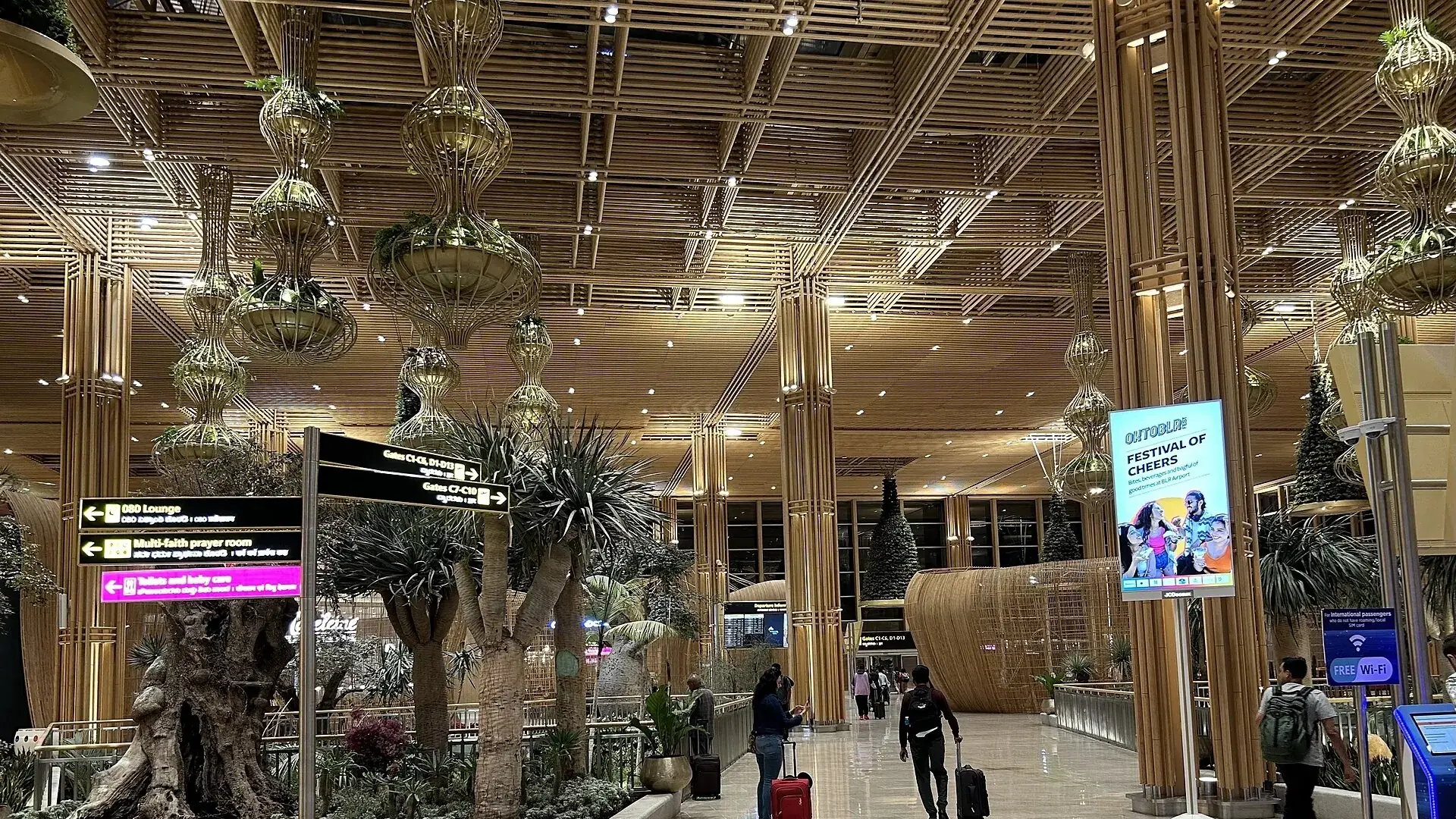
It opened in November 2022. You walk in and the noise drops. Cross-laid engineered bamboo rises in latticework from Kadappa stone floors to a ceiling that filters the Karnataka sun into geometric shade. A forest belt, ninety metres wide and three storeys tall, separates the main building from the gate concourses. To reach your flight, you walk across covered open-air bridges through dense planting of species native to the Western Ghats. The walls are umber red brick. The floors are natural terrazzo. Every material was sourced domestically, every structural detail worked out to let the building breathe. Most Indian airports try to look like Dubai. This one looks like Bengaluru.
SOM Director Peter Lefkovits called it the precedent for the future of airport design. The world's largest terminal pre-certified LEED Platinum by the US Green Building Council chose bamboo over glass and steel not because it needed to. Because the city demanded it.
If you are flying through southern India, route through here. Add an hour to your check-in time and use it inside the building.
Built for the code capital.
Rooted in the garden city.
Bengaluru T2's signature is the forest belt.
Skidmore, Owings and Merrill designed the gate concourses to sit physically separate from the main building, connected by covered bridges through ninety metres of planted outdoor landscape. Three storeys of indigenous flora, footpaths, hanging planters, and waterfalls that reference the boulders and rivers of Karnataka. You do not walk a corridor to your gate. You walk through a garden. At the gate windows, you watch a 787 push back against a wall of green.

Inside the terminal, the bamboo ceiling continues the argument. Cross-laid engineered tubes absorb the concourse echo and filter the light into dappled patches. Teak benches sit on stone floors beside living walls. The silence, in a building serving one of the most overstimulated workforces in India, is the design.
The art programme built into T2 is one of the most ambitious at any Indian airport. Sixty works by forty-three artists, organised around two ideas: Karnataka's cultural heritage and the Navarasa, the nine emotions of Bharatanatyam. Sculptures, textiles, paintings and digital installations are placed throughout the terminal so passengers encounter them on the way to the gate, not detoured into a gallery. The Museum of Art and Photography, Bengaluru's premier institution, runs a rotating partnership with the terminal: a Gallery on Demand in the domestic section, and a permanent exhibition on Padma Shri awardee Bhuri Bai, the Bhil painter from Madhya Pradesh, in the international departures zone.
At the heart of the departures level sits Kalaloka, the only store of its kind at any Indian airport. Mysore silk, Bidriware silver-inlaid metalwork, Ilkal sarees, Lambani embroidery, LIDKAR leather, and Coorg single-origin coffee, all GI-certified, all Karnataka. Karnataka has more GI-tagged products than any other Indian state. Walk to the back and pick up a Channapatna toy. Hand-lacquered on a lathe, vegetable dyes, made sixty kilometres away in a craft tradition two hundred years old. It costs almost nothing. It becomes what you show people when they ask about the trip.


The secret to eating well at Bengaluru T2 is to order South Indian food and to do it before you think you are hungry. The food court here is the real thing, made by people who eat this every day, priced accordingly.
South Indian filter coffee is not optional. It is dark roast ground fine, brewed through a metal filter in two chambers, cut with hot milk and poured between a heavy steel tumbler and a wide-mouthed cup from a height that aerates it and builds the froth. Two dollars. It is better than any seven-dollar flat white in any European airport you have passed through, and the difference is not about equipment. It is about a century of knowing exactly how this should taste. Order it at the food court counter before you do anything else.
For food, go straight to the Terminal 2 food court. The masala dosa: a paper-thin crepe of fermented rice and lentil batter, crisp on the outside and soft inside, stuffed with spiced potato, served with coconut chutney and a hot bowl of sambar. Three dollars. The idli-vada plate: steamed rice cakes with fried lentil doughnuts, dense and clean. The rava kesari for something sweet: semolina halwa fragrant with cardamom and cashew. None of this requires a menu. Point at what is in front of you.
For something to drink before a flight, find the Hatti Kaapi counter in the departures zone. It is a Bengaluru chain built around the filter coffee ritual: steel equipment, no shortcuts. The queue is mostly locals. The price is what it should be. Not the international chain at the other end of the corridor.
Before a long international flight, the T2 food court closes the loop. A full South Indian meal costs less than a single espresso at any European airport you have transited through this year. That is not a complaint about Europe. It is a fact about Bengaluru.
Here is what the seasoned Bengaluru traveller knows that you do not.
First: The Quad by BLR. Bengaluru was the first airport in India to build a landside destination designed for non-passengers as much as travellers. Located near Arrivals on the kerb, The Quad runs over twenty retail and food outlets, a live music arena with a central LED wall, and a flea market zone. The entire complex is open around the clock. People from the city come here who have no flight. It has a bar, proper food, and a stage. If you have been awake since the Outer Ring Road, this is the fastest reset.
Second: Kalaloka closes before the last international departures of the night. If you are on a late flight and want to buy Channapatna toys or Mysore silk, do not leave it to the last hour. The store is near Terminal 2's departures level. Arrive early and go there first.
Third: the shuttle between terminals. Terminal 1 handles many domestic routes with functional efficiency but none of T2's architecture. If you have a long domestic layover at Terminal 1, the free shuttle runs continuously. Ride it to T2, sit in the garden courtyard, drink a filter coffee, return. The twenty-minute round trip changes the quality of the wait entirely.
Fourth: the BMTC Vayu Vajra airport bus runs from the terminal to Majestic and Shivajinagar for around one hundred and twenty rupees. For passengers with heavy luggage and no urgency, it is the cheapest direct connection to the city centre and operates around the clock. The Purple Line metro extension to the airport is under construction. When it opens, all of the above changes.
Bengaluru T2 does not solve the layover problem with commercial amenities. It solves it with the building. The antidote is structural.
The garden courtyards throughout the terminal function as the most calming waiting areas in Indian aviation. Teak benches on stone floors, surrounded by living walls, with the concourse noise absorbed by the bamboo above. No booking required, no fee, no upgrade. Sit there with a coffee. The garden does its work.
For families, the terminal integrates play areas near the boarding gates. The forest belt is itself a space for children old enough to walk through it: the covered bridges, paths, and hanging planters do what no screen-based entertainment zone achieves. Stroller access is level throughout. Baby care rooms are distributed across both levels.
The 080 Lounge is the right answer. The quiet library-style seating at the back is the best workspace in the complex: natural light through bamboo-screened windows, reliable Wi-Fi, distance from the departure boards. The Taj Hotel at the airport rents day rooms for passengers who need a proper bed and a shower. Both are short walks from the departure gates.

You have two hours. Or four. Or eight. Or thirteen. Here is what to do.
Filter coffee at the food court. Masala dosa. Walk to Kalaloka. Buy the Channapatna toy. Sit in the garden courtyard before the gate calls.
Ayurvedic head massage in the departures zone. 080 Lounge for a craft beer. Walk the forest belt bridges. Return unknotted.
BMTC Vayu Vajra bus to the city. Ninety minutes on the Ring Road. Lalbagh Botanical Garden. VV Puram Food Street for chaat. Bus back.
Bus or cab to Indiranagar. Brunch at Toit brewery. Walk to Commercial Street. Cubbon Park. Dinner in Koramangala. Cab back with time for a filter coffee before departure.
The BMTC Vayu Vajra bus runs to Majestic and Shivajinagar for around one hundred and twenty rupees. App cabs run six hundred to eight hundred rupees and take sixty to ninety minutes. The Purple Line metro extension to the airport is under construction. When it opens, all of this changes.
Bengaluru's photograph is the departure gate.
Stand at the glass wall of any gate in the T2 concourse at dusk. Switch to 0.5x wide angle. Frame the aircraft pushing back from the stand. The forest belt is behind the aircraft: three storeys of dense green foliage, lit by the last of the Karnataka evening light, the Ghats visible in the distance on a clear day.
This is the photograph that does not look like an airport. The terminal emerges from the tree line like a machine that chose its location deliberately. SOM built T2 to produce exactly that tension. The city that runs India's technology sector, still rooted in the garden it refuses to pave over.