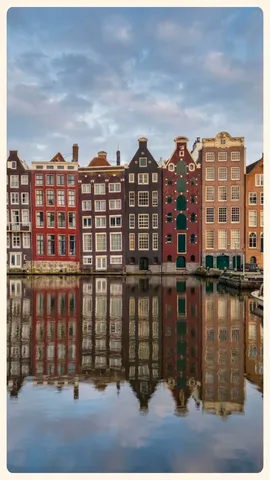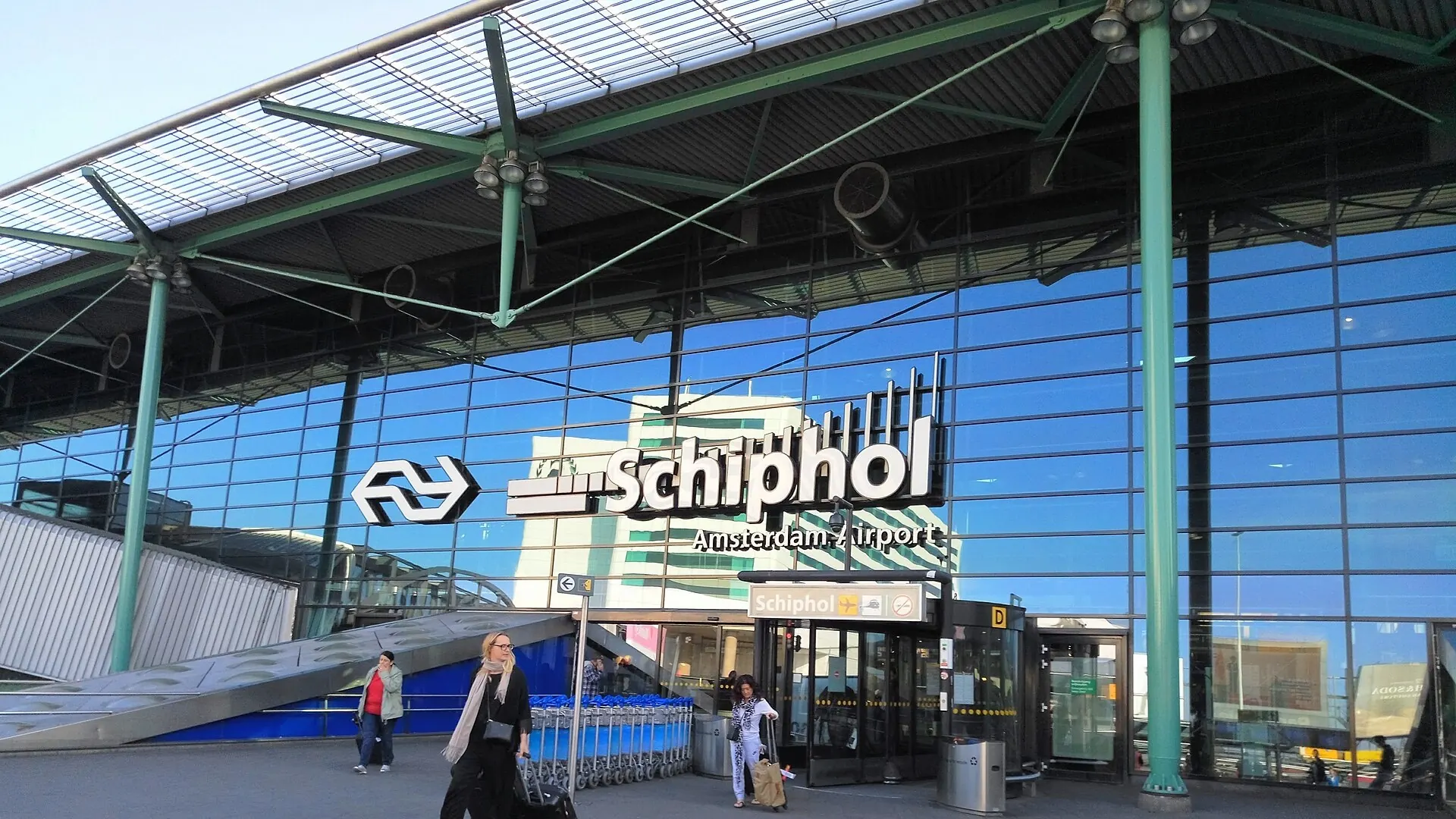
Schiphol was designed for the passenger who arrives with time to spend. Schiphol wants you to stay. It is the only major airport in the world that gives you a working annex of the national museum, a public library, a silent interfaith room, and a rooftop with a retired KLM jet on it. Free. Most of them open around the clock. Less a transit facility than a public square with planes attached.
This is a Dutch idea of an airport, which is to say a Dutch idea of public space. Built four metres below sea level on the drained bed of the Haarlemmermeer, the terminal sits on ground that was a lake until 1852. The country that pumped out an inland sea to make room for a runway was never going to build just a runway. It built a civic room.
The numbers follow the philosophy. Six runways. One terminal, three departure halls, all piers connected airside. Home of KLM, the oldest airline still operating under its original name, founded 7 October 1919.
If you connect through Europe and have the choice, route through Schiphol. And if your layover is six hours or more, leave the airport. The train to Amsterdam Centraal runs from under the terminal and takes seventeen minutes.
One terminal.
Every continent.
Schiphol's signature is Holland Boulevard.
A 5,000 square metre airside corridor between Lounges 2 and 3 in the non-Schengen zone, designed by NEXT Architects, opened 2019. It takes the Dutch polder landscape as its model and arranges the space as a series of sitting rooms, each with its own character, separated by low walls. It is gezelligheid, the Dutch word for warm inviting togetherness, rendered in glass and timber at terminal scale.

At the heart of it sits the Rijksmuseum Schiphol, the first airport museum in the world, opened 2002. Around ten original works from the Dutch Golden Age hang in a glass pavilion between piers E and F. The collection rotates. Admission is free. The room is open twenty-four hours. You walk in with your carry-on, stand in front of a real Pieter de Hooch, and walk out.
Next to it, the Airport Library: roughly five hundred books by Dutch authors in over forty languages, oversized sofas, a piano that any passenger can play. Retired librarians from the Dutch national system look after the shelves. Read on the spot, or leave a book for whoever comes next. Around the corner, the NEMO Science outpost flanked by two giant sculptures by Florentijn Hofman. Across the boulevard, the House of Tulips sells fresh-cut blooms in green crates under Delft blue ceramics, the whole of Dutch floriculture in one shop.
One floor up in Lounge 2, at the entrance to Pier E, the Meditation Centre. A silent, non-denominational room with a qibla marker and holy texts in many languages, staffed by airport chaplains during the day. Around sixty thousand people visit each year. The only silent interfaith space behind security at a major hub, open around the clock, free of charge.


The secret to eating well at Schiphol is to eat Dutch, and to know that the most Dutch food in the airport is landside, in Schiphol Plaza, before you clear security.
FEBO opened at Schiphol Plaza in April 2024, the first airport branch in the chain's eighty-three year history. It is a working automat: a glass wall of small heated windows, each holding a kroket, a frikandel, a kaassoufle, or a hamburger. Tap your card. A window unlocks. Take your snack. The kroketten are made fresh each morning at FEBO's Amsterdam kitchen using Dutch beef. It is the most Dutch five minutes you will spend at the airport, and it costs about three euros.
A few steps away, Cafe Rembrandt is the consensus pick for bitterballen: deep-fried balls of beef ragout, served scalding hot with sharp mustard and a draft Heineken. Order a dozen. Do not bite immediately. Airside, bitterballen continue at the Heineken bars throughout the concourses and at Dutch Kitchen, Bar & Cocktails on Holland Boulevard, where Dutch pancakes, Amsterdam croquettes, and sandwiches keep the theme going.
For the sugar rush, find the stroopwafel counters where two thin waffle layers are pressed around hot caramel in front of you. La Place on the upper level does proper Dutch pancakes, fresh soups, and stamppot. And if you trust yourself, the raw herring counters will hand you a whole fish by the tail with chopped onion. Tip your head back. That is how the Netherlands actually tastes.
For coffee, skip the chains. Order a koffie verkeerd, the Dutch milky coffee, at Cafe Rembrandt or any of the espresso bars along Holland Boulevard. Drink it with a warm stroopwafel on the side.
Here is what the seasoned Schiphol traveller knows that you do not.
First, and most famous: the urinal fly. Walk into any men's restroom at Schiphol and look at the porcelain. You will see a small photorealistic housefly etched near the drain, slightly off to the left. It is not a mistake. It was placed there in the early 1990s by cleaning manager Jos van Bedaf and facilities chief Aad Kieboom, who wanted to give men something to aim at. It reduced spillage by eighty percent and cleaning costs by eight percent. Richard Thaler cited it in Nudge, the book that won him the 2017 Nobel Prize in Economics. He has called it his favourite example of a nudge. Every airport urinal fly on Earth is a descendant of this one.
Second: OVpay. Skip the ticket machines at the station. The yellow contactless readers at the platform gates accept any foreign debit or credit card. Tap in at Schiphol, tap out at Amsterdam Centraal, and you are charged the standard fare of around five euros fifty. No ticket. No queue. Use the same card for both taps or the system will charge a penalty.
Third: the free EF showers. Past security, between piers E and F, follow the signs to First Aid. There are free shower cubicles for any departing or transit passenger. Bring your own towel and soap. No booking, no fee, no lounge required. Airport staff know about them. Most passengers do not.
Fourth: the Polderbaan warning. Schiphol has six runways. The Polderbaan, runway 18R-36L, sits so far from the terminal that the taxi from touchdown to gate can take twelve to fifteen minutes. If your inbound is on the Polderbaan and your connection is tight, tell the cabin crew before landing. And if your outbound is from pier H, start walking ten minutes earlier than you think you need to.
Schiphol does not solve the layover with a single grand gesture. It solves it the Dutch way: in pieces, spread quietly across the terminal, free to find if you know where to look.
For sleep, YotelAir above Lounge 2 rents pod-style cabins from four hours upwards, hand baggage only, shower included. GoSleep Pods on Concourse D rent by the hour for quick naps. The Mercure Schiphol Terminal Hotel sits airside in Lounge 3 with day-use rooms as well as overnight stays. Landside, the Hilton and Sheraton are a short covered walkway across Schiphol Plaza, under ten minutes on foot.
For families, the Kids Forest in Lounge 2 is a nature-themed play zone with climbing frames and a plane-shaped structure for burning off gate energy. The Baby Care Lounge on Holland Boulevard has private cabins for feeding, bathing, and napping infants, with cots and low lights. Both are free.
The KLM Crown Lounge 52 near pier F is the flagship: the Blue restaurant, an outdoor terrace overlooking the apron. Flying Blue Gold or above, take it. The Aspire Lounge 41, reopened February 2024 after a full refurbishment, takes Priority Pass and DragonPass with floor-to-ceiling ramp views. Walk-in around fifty euros for three hours.

You have two hours. Or four. Or eight. Or thirteen. Here is what to do.
Stay airside. Walk Holland Boulevard. Rijksmuseum, Library, ten minutes each. Bitterballen and a Heineken. Return to gate with the strange sensation of having enjoyed an airport.
Still airside. Add the Meditation Centre and a free shower at the EF cubicles. Lunch at Dutch Kitchen, Bar & Cocktails or La Place. Stroopwafel on the way back to the gate.
Clear immigration. Train to Centraal, seventeen minutes. Canal walk through the Nine Streets and the Jordaan. Lunch at a brown cafe. Train back with ninety minutes to spare.
Train to Centraal. Two hours at the real Rijksmuseum. Canal boat from Damrak. Rijsttafel dinner in Chinatown: the colonial-era Indonesian feast. Train back. Nap at YotelAir.
The NS train from Schiphol to Amsterdam Centraal runs every ten minutes, takes seventeen, and costs around five euros fifty one way. The bus takes thirty minutes and suits heavy luggage. A taxi costs forty to sixty euros. For most layovers, take the train.
Schiphol's photograph is the Fokker on the roof.
Stand on the Panorama Terrace, landside, above Departures 1. A retired KLM Fokker 100, registration PH-OFE, was craned up in 2011 and sits there as a walk-in exhibit. Switch to 0.5x wide angle. Frame the blunt nose of the Fokker in the foreground. Wait for a live KLM 777 to rotate off the Aalsmeerbaan behind it.
This is the photograph that captures what Schiphol actually is. Heritage and velocity in one frame. A retired aircraft and a working runway, no ticket required, arranged by an airport that decided long ago that looking at planes should be a public good.